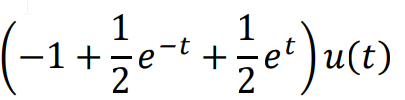
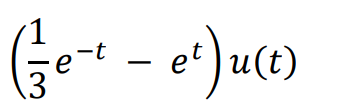
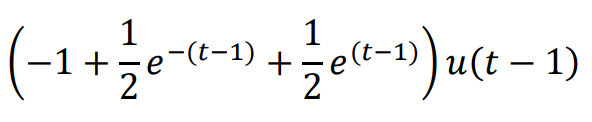
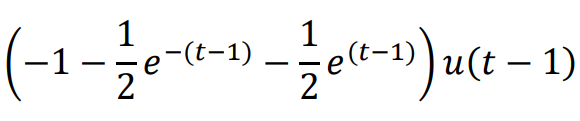
Which one of the options given is the inverse Laplace transform of 1/ (𝑠3−𝑠 )? 𝑢(𝑡) denotes the unit-step function.
Correct Answer :
Solution :
The correct option is:
Step-by-step Derivation:
We are given the Laplace domain function:
First, factor the denominator:
Thus, the expression becomes:
Next, we perform a partial fraction decomposition:
We can determine the coefficients , , and using the cover-up method:
For , multiply by and evaluate at :
For , multiply by and evaluate at :
For , multiply by and evaluate at :
Substitute these values back into the partial fraction expansion:
Now, apply the inverse Laplace transform to each individual term:
- Using the standard transform pair , we have:
- Using the standard transform pair , we have:
and:
Summing the individual inverse transforms yields:
Access expert-curated educational resources and study materials—completely free.
Create, conduct, and manage professional online assessments with Crey. Perfect for teachers and institutes.
Copyright © 2026 Crey. All Rights Reserved.