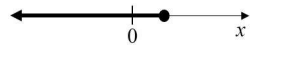
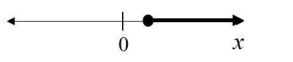
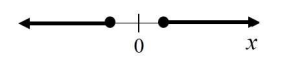
Which one of the following is a representation (not to scale and in bold) of all values of x satisfying the inequality on the real number line?
Correct Answer :
Solution :
The correct option is the third option: <p><a href="https://ta-spaces.blr1.cdn.digitaloceanspaces.com/ta-prod/uploads/qk7445-1720586327736.png" data-fancybox="gallery">[IMAGE PROVIDED BELOW]</a></p> which is represented by the number line diagram showing a solid, closed dot positioned to the right of 0 (representing a positive value) with a bold arrow extending to the right.
To determine why this is the correct option, let's solve the given inequality step-by-step:
Step 1: Eliminate the fraction
Multiply both sides of the inequality by . Since is a positive number, the direction of the inequality sign remains unchanged:
Step 2: Expand both sides
Distribute the on the left side and distribute the negative sign on the right side:
Step 3: Collect terms containing
Add to both sides to make the coefficient of the variable positive:
Step 4: Isolate the variable term
Subtract from both sides:
Dividing both sides by gives:
Step 5: Represent the solution on the number line
The solution set contains all values of greater than or equal to :
1. The inequality contains a "greater than or equal to" () relation. This requires a closed (solid) dot at the boundary point to show that is included in the solution set.
2. Because is positive, the solid dot must be situated to the right of the origin (0).
3. Since the inequality specifies values greater than the boundary, the line must be shaded in bold pointing to the right towards positive infinity.
Comparing this criteria against the options:
- Option 1 (image_0.png): Shows a solid dot to the right of 0 with the arrow pointing to the left (representing where ).
- Option 2 (image_1.png): Shows a solid dot to the left of 0 with the arrow pointing to the right (representing where ).
- Option 3 (image_2.png): Shows a solid dot to the right of 0 with the arrow pointing to the right (representing where ).
- Option 4 (image_3.png): Shows two disjoint rays pointing outwards (representing a compound inequality).
Hence, Option 3 is the correct representation.
Access expert-curated educational resources and study materials—completely free.
Create, conduct, and manage professional online assessments with Crey. Perfect for teachers and institutes.
Copyright © 2026 Crey. All Rights Reserved.