Which of the following will not give SN1.
Correct Answer :
Solution :
The correct option is CH₃ – CH = CH – Cl.
To understand why this compound does not undergo the mechanism, let us analyze the reactivity of each given option towards nucleophilic substitution:
1. CH₂ = CH – CH₂ – Cl (Allyl chloride):
When the chloride ion leaves, it forms the allyl carbocation:
This carbocation is highly stable because the positive charge is delocalized over the adjacent carbon-carbon double bond via resonance:
Therefore, it readily undergoes reaction.
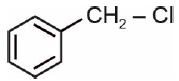
2. Benzyl chloride (shown in the first image, C₆H₅ – CH₂ – Cl):
Ionization of benzyl chloride yields the benzyl carbocation:
This carbocation is exceptionally stable due to the resonance delocalization of the positive charge throughout the aromatic benzene ring. Hence, it undergoes reactions very easily.
3. tert-Butyl chloride (shown in the second image, (CH₃)₃C – Cl):
Upon loss of chloride, it forms a tertiary carbocation:
A tertiary carbocation is stabilized by nine hyperconjugative hydrogens (from three methyl groups) and strong electron-donating inductive effects (+I). Thus, it undergoes reactions very rapidly.
4. CH₃ – CH = CH – Cl (1-chloroprop-1-ene / Vinylic halide):
In this compound, the chlorine atom is directly attached to an sp² hybridized carbon atom (vinylic carbon). The lone pairs on the chlorine atom undergo resonance with the double bond:
This resonance imparts a partial double-bond character to the C – Cl bond, making it shorter, stronger, and extremely difficult to cleave. Furthermore, if the C – Cl bond were to break, it would produce a vinylic carbocation:
This vinylic carbocation is highly unstable because the positive charge resides on a highly electronegative sp² hybridized carbon. Due to both the strength of the C – Cl bond and the instability of the resulting carbocation, this compound does not undergo substitution reactions.
Access expert-curated educational resources and study materials—completely free.
Create, conduct, and manage professional online assessments with Crey. Perfect for teachers and institutes.
Copyright © 2026 Crey. All Rights Reserved.