Which of the following is most acidic?
Correct Answer :
Solution :
The correct answer/option is the fourth option: 2,4-dinitrophenol (represented by the image showing a benzene ring with a hydroxyl group () at position 1, and two nitro groups () at positions 2 and 4).
To determine which compound is the most acidic, we must examine the stability of the conjugate base (anion) formed after the release of a proton (). A more stable conjugate base corresponds to a stronger acid.
Let us evaluate each of the given options step-by-step:
1. Butanol ():
Butanol is an aliphatic alcohol. Its conjugate base is the butoxide ion (). The negative charge on the oxygen atom cannot be stabilized by resonance. Furthermore, the butyl group exerts an electron-donating inductive effect (), which increases the electron density on the oxygen atom and destabilizes the anion. Consequently, aliphatic alcohols are extremely weak acids with a high value of approximately 16.
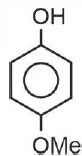
2. 4-Methoxyphenol (Image 0):
This structure displays a phenol ring with a methoxy group () at the para-position. Although the methoxy group has a weak electron-withdrawing inductive effect (), it is dominated by its strong electron-donating resonance effect () due to the lone pairs on the oxygen atom. This resonance effect increases the electron density on the phenoxide ring, destabilizing the conjugate base and reducing the acidity ().
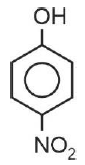
3. 4-Nitrophenol (Image 1):
This structure shows a phenol ring with a single nitro group () at the para-position. The nitro group is a powerful electron-withdrawing group via both inductive () and mesomeric/resonance () effects. Since the nitro group is located at the para-position, it can directly participate in the resonance delocalization of the negative charge from the phenoxide oxygen, significantly stabilizing the conjugate base ().
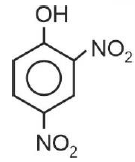
4. 2,4-Dinitrophenol (Image 2):
This structure contains a phenol ring with two nitro groups: one at the ortho-position (position 2) and one at the para-position (position 4) relative to the hydroxyl group. Both of these positions are conjugated with the phenoxide oxygen atom. As a result, the negative charge of the conjugate base is strongly withdrawn and delocalized by both nitro groups through resonance () and inductive () withdrawal. This synergistic stabilization makes the conjugate base highly stable, resulting in a significantly lower value of approximately 4.0.
Comparing all options, 2,4-dinitrophenol has the most stable conjugate base, which makes it the most acidic compound.
Access expert-curated educational resources and study materials—completely free.
Create, conduct, and manage professional online assessments with Crey. Perfect for teachers and institutes.
Copyright © 2026 Crey. All Rights Reserved.