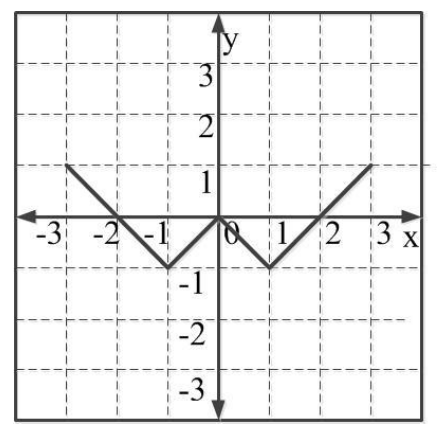
Which of the following functions describe the graph shown in the below figure?
Correct Answer :
𝑦 = ||𝑥| − 1| − 1
Solution :
The correct answer is:
By analyzing the provided graph, we can identify several key coordinates and features:
1. The local minimums (bottom peaks/cusps) are located at and .
2. The local maximum is at the origin .
3. The graph crosses the x-axis (x-intercepts) at and .
4. The graph passes through the points and .
We can verify the correct function by substituting these x-values:
• For :
This correctly corresponds to the point .
• For :
This correctly corresponds to the vertices at and .
• For :
This correctly corresponds to the x-intercepts at and .
Alternatively, we can understand the graph step-by-step through transformations:
1. Start with the parent absolute value function: (V-shape with vertex at ).
2. Shift down by 1 unit: (vertex shifts to ).
3. Reflect negative parts: Applying the outer absolute value reflects the portion below the x-axis upwards. The vertex at reflects to , and new cusps are formed on the x-axis at and .
4. Final Shift down by 1 unit: Subtracting 1 to get shifts the entire graph down. The peak at shifts to and the cusps shift down to and , perfectly matching the given graph.
Access expert-curated educational resources and study materials—completely free.
Create, conduct, and manage professional online assessments with Crey. Perfect for teachers and institutes.
Copyright © 2026 Crey. All Rights Reserved.