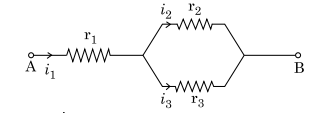
Three resistors having resistances r1, r2 and r3 are connected as shown in the given circuit. The ratio i₃/i₁ of currents in terms of resistances used in the circuit is :
Correct Answer :
Solution :
The correct option is r₂/(r₂ + r₃).
Step-by-step Explanation:
1. Identify the current division:
From the given circuit diagram, we can see that the total current entering terminal A is , which passes through resistor . At the junction, this current splits into two parallel branches containing resistors and carrying currents and respectively. According to Kirchhoff's Current Law (KCL):
2. Apply the parallel voltage relation:
Since the resistors and are connected in parallel, the potential difference (voltage drop) across both resistors is equal. By Ohm's law:
3. Express in terms of :
4. Substitute back into the current equation:
Factoring out gives:
Simplifying the expression in the parentheses:
5. Find the ratio :
Rearranging the equation to solve for the ratio of to :
Access expert-curated educational resources and study materials—completely free.
Create, conduct, and manage professional online assessments with Crey. Perfect for teachers and institutes.
Copyright © 2026 Crey. All Rights Reserved.