Correct Answer :
Solution :
The correct option is c/(c+1).
Analysis of the Given Problem:
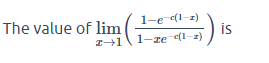
Based on the provided question images, we are required to evaluate the limit:
Step 1: Check the form of the limit
As shown in the second image, if we directly substitute into the expression:
• The numerator becomes:
• The denominator becomes:
Since the limit yields an indeterminate form of , we can apply L'Hôpital's rule.
Step 2: Differentiate the numerator and the denominator
L'Hôpital's rule states that for an indeterminate form of , the limit is equal to the limit of the ratio of their derivatives.
Let us find the derivative of the numerator with respect to :
Since , its derivative with respect to is . Therefore:
Now, let us differentiate the denominator with respect to using the product rule:
Simplifying this expression:
Step 3: Set up the ratio of derivatives
Substituting the derivatives back into the limit, we get:
We can factor out and cancel the term from both the numerator and the denominator:
Step 4: Evaluate the limit
Now, substitute into the simplified expression:
Thus, the final evaluated limit matches the correct option.
Access expert-curated educational resources and study materials—completely free.
Create, conduct, and manage professional online assessments with Crey. Perfect for teachers and institutes.
Copyright © 2026 Crey. All Rights Reserved.