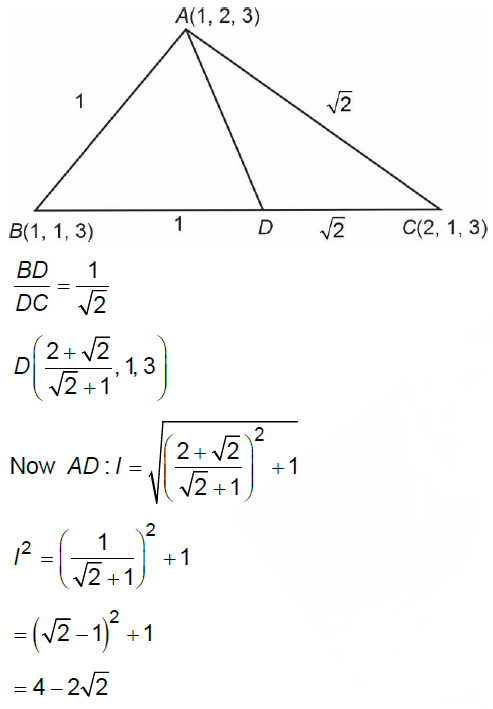
The position vector of vertices A, B, C of Δ are respectively. Let l is the length of angle bisector of ∠BAC , then the value of l2 is
Correct Answer :
Solution :
The correct option is 4 - 2√2.
From the given information and the provided diagram, we are given a triangle where the position vectors of the vertices are:
Vertex , which corresponds to the coordinates .
Vertex , which corresponds to the coordinates .
Vertex , which corresponds to the coordinates .
Step 1: Find the lengths of the sides AB and AC
The length of side is calculated using the distance formula:
Similarly, the length of side is:
Step 2: Apply the Angle Bisector Theorem
Let the angle bisector of meet the side at a point .
According to the Angle Bisector Theorem, the bisector of an angle divides the opposite side in the ratio of the lengths of the other two sides. Therefore:
This shows that point divides the line segment joining and internally in the ratio .
Step 3: Determine the coordinates of point D
Using the section formula, the coordinates of are:
Simplifying each coordinate:
Step 4: Find the length of the angle bisector AD (l)
Let be the length of . The distance between and is given by:
Let us simplify the term :
Substituting this back into the expression for :
Squaring both sides to find :
Step 5: Simplify the final expression
Rationalize the denominator of the fraction:
Now, substitute this value into the equation for :
Expand the squared term:
Access expert-curated educational resources and study materials—completely free.
Create, conduct, and manage professional online assessments with Crey. Perfect for teachers and institutes.
Copyright © 2026 Crey. All Rights Reserved.