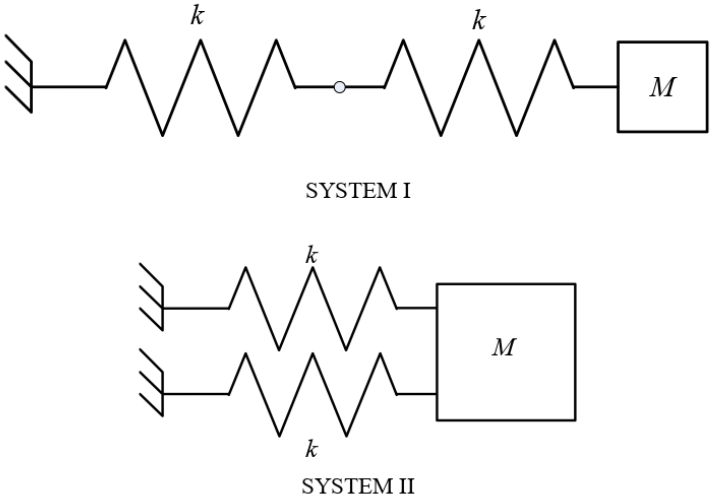
The natural frequencies corresponding to the spring-mass systems I and II are ωI and ωII, respectively. The ratio ωI / ωII is
Correct Answer :
1/2
Solution :
The correct option is 1/2.
Image Analysis and Setup:
Based on the visual representation of the spring-mass systems in the provided image:
Let us analyze the natural frequencies of both systems step-by-step.
Step 1: Natural Frequency of System I (Series Configuration)
When two springs of stiffness constant k are connected in series, the equivalent stiffness constant is given by:
Taking the reciprocal, we get the equivalent stiffness for System I:
The natural frequency of System I () is:
Step 2: Natural Frequency of System II (Parallel Configuration)
When two springs of stiffness constant k are connected in parallel, the equivalent stiffness constant is the sum of the individual stiffnesses:
The natural frequency of System II () is:
Step 3: Calculating the Ratio of natural frequencies
To find the ratio of to , we divide the expressions derived in Step 1 and Step 2:
Combining the terms under a single square root:
Canceling the common parameters k and m:
Therefore, the ratio of natural frequencies is 1/2.
Access expert-curated educational resources and study materials—completely free.
Create, conduct, and manage professional online assessments with Crey. Perfect for teachers and institutes.
Copyright © 2026 Crey. All Rights Reserved.