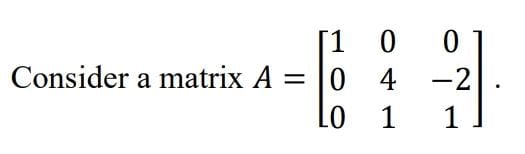
The matrix A satisfies the equation 6A-1=A2+cA+dl where c and d are scalars and I is the identity matrix. Then (c+d) is equal to
Correct Answer :
5
Solution :
The correct option is 5.
Step-by-step Explanation:
First, we refer to the provided image which defines the matrix 3 × 3 matrix as:
To find the equation satisfied by , we can determine its characteristic equation using:
Expanding along the first row, we get:
Simplifying the terms inside the brackets:
Expanding this product:
Multiplying by -1, we obtain the characteristic equation:
According to the Cayley-Hamilton Theorem, every square matrix satisfies its own characteristic equation. Therefore:
Since the determinant of is , the matrix is invertible. Multiplying the entire equation by the inverse matrix :
Rearranging the equation to isolate :
Now, we compare this derived equation with the given equation:
By equating the corresponding coefficients:
We need to calculate the value of :
Access expert-curated educational resources and study materials—completely free.
Create, conduct, and manage professional online assessments with Crey. Perfect for teachers and institutes.
Copyright © 2026 Crey. All Rights Reserved.