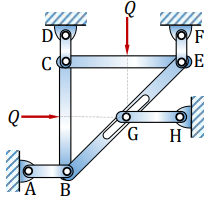
The lengths of members BC and CE in the frame shown in the figure are equal. All the members are rigid and lightweight, and the friction at the joints is negligible. Two forces of magnitude 𝑄 > 0 are applied as shown, each at the mid-length of the respective member on which it acts.
Which one or more of the following members do not carry any load (force)?
Correct Answer :
Solution :
The correct option is GH.
To determine which member does not carry any load, we can analyze the equilibrium of the joints and members of the frame. Let's break down the analysis step-by-step:
1. Analysis of Member GH:
Member GH is pinned at support H and connected to pin G. There are no external forces or moments acting along the span of member GH. Thus, member GH acts as a two-force member. This means the force carried by member GH, which we denote as , must act along the line joining G and H. Since GH is horizontal, the force acts purely in the horizontal direction.
2. Analysis of the Pin-in-Slot Joint at G:
Pin G is constrained to slide inside a smooth, frictionless slot cut along member BE.
Because the slot is frictionless, it cannot resist any motion parallel to its length. Therefore, the reaction force exerted by member BE on pin G must be a normal reaction force () that acts perpendicular to the axis of member BE.
3. Inclination of Member BE:
From the given geometry in the figure, member BC is vertical, and member CE is horizontal. The lengths of BC and CE are equal. Consequently, the diagonal member BE is inclined at an angle:
with respect to the horizontal. Since the normal reaction force is perpendicular to BE, it is also inclined at to both the horizontal and vertical directions.
4. Equilibrium of Pin G:
Let us analyze the forces acting on the pin G. Pin G is in static equilibrium under the action of:
1. The force from member GH, (directed horizontally).
2. The normal reaction force from the slot, (inclined at to the horizontal and vertical).
Applying the equations of static equilibrium for pin G:
First, considering the equilibrium of forces in the vertical direction (-axis):
Since , this directly requires:
Next, considering the equilibrium of forces in the horizontal direction (-axis):
Substituting into the horizontal force equation yields:
Since the axial load in member GH is zero, member GH does not carry any load.
Access expert-curated educational resources and study materials—completely free.
Create, conduct, and manage professional online assessments with Crey. Perfect for teachers and institutes.
Copyright © 2026 Crey. All Rights Reserved.