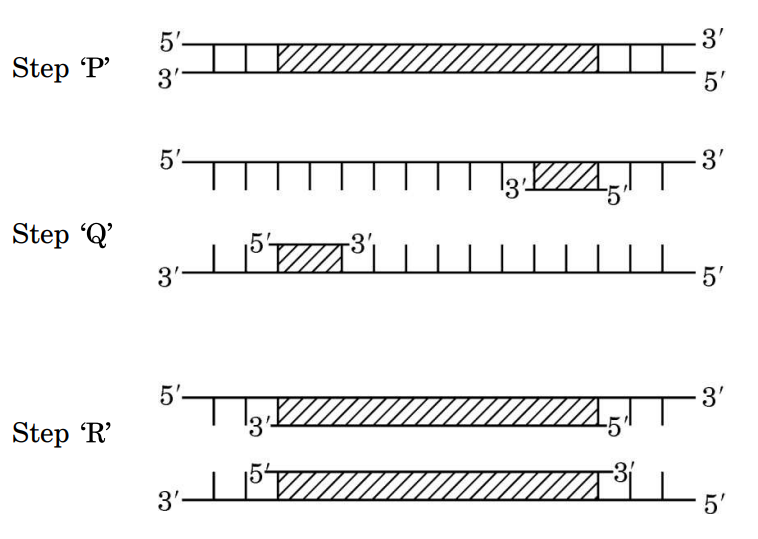
The given schematic illustration shows three steps 'P', 'Q' and 'R' of the polymerase chain reaction. Which of the following statements are correct with reference to the illustration given above ?
(i) Step 'P' is showing denaturation at low temperature.
(ii) Step 'Q' is a denaturation of DNA strand at high temperature, followed by annealing.
(iii) Step 'R' is an extension of DNA in presence of thermostable DNA polymerase.
(iv) Step 'Q' is extension with two sets of primers.
Correct Answer :
Solution :
The correct option is (ii) and (iii) only.
Based on the schematic illustration of the Polymerase Chain Reaction (PCR) process, we can analyze the three steps as follows:
1. Step 'P' (Denaturation):
This represents the double-stranded template DNA. During the denaturation step of PCR, the reaction mixture is heated to a high temperature (typically 94°C to 96°C) to separate the two complementary DNA strands by breaking the hydrogen bonds between the base pairs. Therefore, statement (i) is incorrect because denaturation occurs at a high temperature, not a low temperature.
2. Step 'Q' (Annealing):
This step shows the primers (short, single-stranded DNA sequences shown as hatched/shaded blocks with 5' and 3' ends) binding to their complementary target regions on the single-stranded template DNA. The annealing step happens at a lower temperature (typically 50°C to 65°C) after the double-stranded DNA has undergone denaturation at a high temperature. Therefore, statement (ii) is correct as it describes the denaturation of the DNA strand at high temperature followed by annealing. Statement (iv) is incorrect because step 'Q' represents annealing, not extension.
3. Step 'R' (Extension):
This step shows the extension of the primers. A thermostable DNA polymerase (typically Taq polymerase) adds nucleotides to the 3'-hydroxyl (3'-OH) end of the annealed primers at an optimum temperature of about 72°C. This synthesizes a new complementary strand along the template. Thus, statement (iii) is correct.
Hence, statements (ii) and (iii) are the only correct statements.
Access expert-curated educational resources and study materials—completely free.
Create, conduct, and manage professional online assessments with Crey. Perfect for teachers and institutes.
Copyright © 2026 Crey. All Rights Reserved.
 Set - 3-1782888548748.webp)