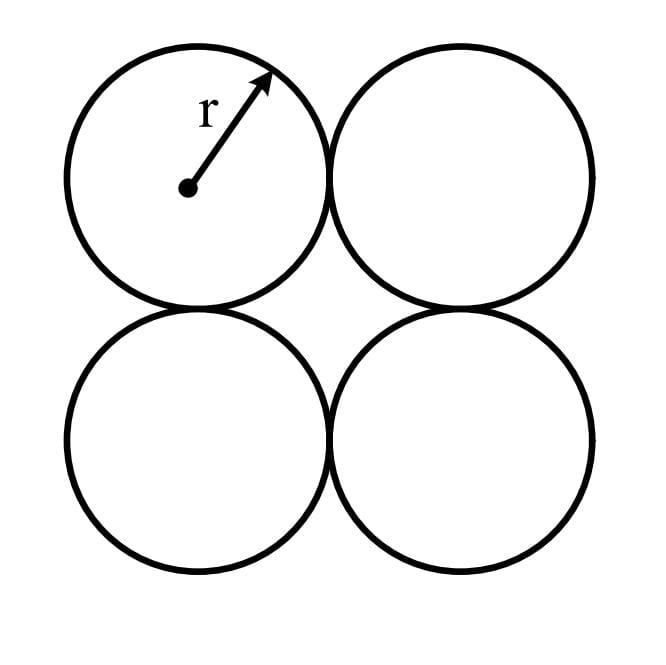
The geometric mean radius of a conductor, having four equal strands with each strand of radius ‘r’, as shown in the figure below, is
Correct Answer :
1.723 r
Solution :
The correct option is 1.723 r.
Step-by-Step Explanation:
From the provided image, we observe four identical solid circular strands, each of radius r, arranged in a symmetrical square configuration such that each strand is touching its adjacent strands.
Let the centers of the four strands be labeled as 1, 2, 3, and 4 in a clockwise order.
1. Distance Between Strand Centers:
Since adjacent strands are touching, the distance between their centers is equal to twice the radius:
The distance between diagonal strands (e.g., between strand 1 and strand 3) can be calculated using the Pythagorean theorem:
2. Self-GMR of a Single Strand:
The self-geometric mean radius (GMR) of a single solid circular conductor, accounting for internal flux linkage, is given by:
3. Overall Geometric Mean Radius (GMR) of the Conductor:
Since all four strands are identical and symmetrically positioned, the overall GMR (denoted as ) is calculated as:
Substituting the distance values:
Simplifying the product inside the parentheses:
Substituting :
Calculating the fourth root:
Access expert-curated educational resources and study materials—completely free.
Create, conduct, and manage professional online assessments with Crey. Perfect for teachers and institutes.
Copyright © 2026 Crey. All Rights Reserved.