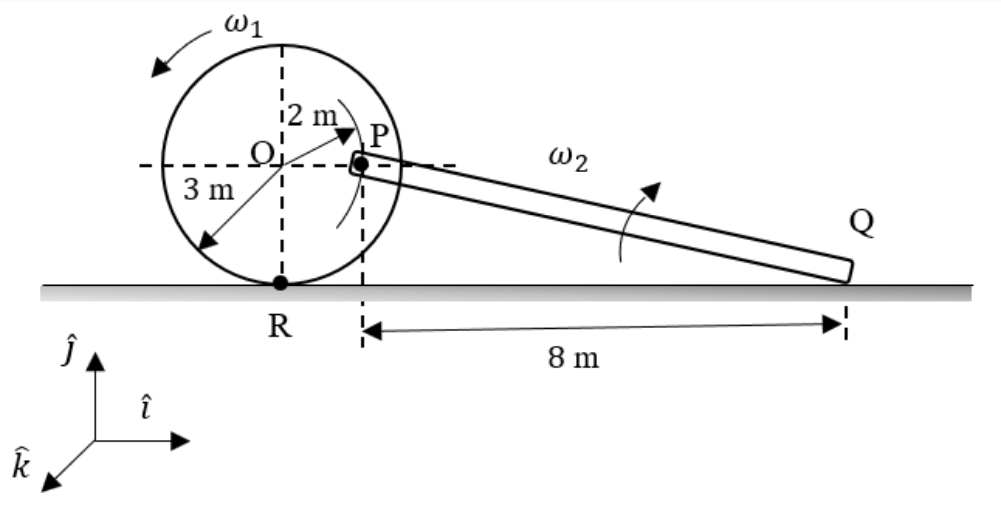
The figure shows a wheel rolling without slipping on a horizontal plane with angular velocity 𝜔1. A rigid bar PQ is pinned to the wheel at P while the end Q slides on the floor. What is the angular velocity 𝜔2of the bar PQ?
Correct Answer :
𝜔2 = 0.25𝜔1
Solution :
The correct answer is:
Step-by-Step Explanation:
We can solve this problem using two different elegant methods: the Instantaneous Center of Rotation (I-Center) Method using Kennedy's Theorem and the Vector Velocity Method.
Method 1: Instantaneous Center (I-Center) Method (Kennedy's Theorem)
Let us define the links in the system:
• Link 1: The fixed ground (surface)
• Link 2: The rolling wheel (disc)
• Link 3: The rigid bar PQ
1. Identify the I-centers of the individual links:
• Since the wheel (Link 2) rolls without slipping on the ground (Link 1), the instantaneous center of rotation between Link 1 and Link 2, denoted as , lies at the point of contact R.
• The pin joint P connects the wheel (Link 2) and the bar (Link 3). Hence, the relative I-center between Link 2 and Link 3 is located at the pin P, denoted as .
• The end Q of the bar PQ slides along the horizontal floor (Link 1). Therefore, the velocity of Q is purely horizontal, meaning its perpendicular line of motion is vertical. Thus, the I-center of the bar relative to the ground, denoted as , must lie on the vertical line passing through Q.
2. Apply Kennedy's Three-Center Theorem:
Kennedy's theorem states that if three bodies have relative motion, their three relative I-centers must lie on a straight line. Therefore, the I-centers (at R), (at P), and must be collinear.
This collinear line passes through the point of contact R and the pin joint P , and extends to meet the vertical line through Q at .
3. Use Geometry and Similar Triangles:
From the given image:
• The radius of the wheel is , so the vertical height of P above R is .
• The horizontal distance from the center O to P is .
• The horizontal distance from the vertical line through P to the point Q is .
Let B be the projection of P on the ground line. The triangle formed by , B, and P is similar to the triangle formed by (P), A (horizontal projection of Q at the level of P), and .
Using similar triangles:
Substituting the horizontal lengths:
4. Calculate Angular Velocity Relationship:
Since P is the common point between the wheel (rotating with about ) and the bar (rotating with about ), the velocity of point P can be written as:
Rearranging the equation:
Method 2: Vector Velocity Method
Let us place a coordinate system at the center of the wheel O, with unit vectors pointing horizontally to the right and pointing vertically upwards.
• The contact point with the floor is .
• The pin joint P is located at .
• The velocity of point P on the wheel, relative to the instantaneous center of rotation R, is:
Since the wheel rotates counterclockwise with and the position vector is :
The magnitude of the velocity of P is:
Now consider the rod PQ rotating with angular velocity about its own instantaneous center :
• Since Q slides on the horizontal floor, the I-center has the coordinates relative to O, or relative to P is .
• The velocity vector of P must be perpendicular to the position vector :
Thus, the distance from P to the I-center of the bar is:
Therefore, the angular velocity of the bar is:
Access expert-curated educational resources and study materials—completely free.
Create, conduct, and manage professional online assessments with Crey. Perfect for teachers and institutes.
Copyright © 2026 Crey. All Rights Reserved.