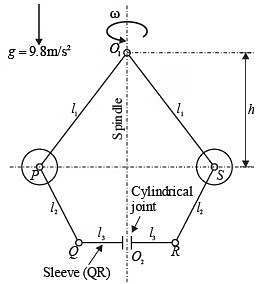
The figure shows a schematic of a simple Watt governor mechanism with the spindle O1O2 rotating at an angular velocity ω about a vertical axis. The balls at P and S have equal mass. Assume that there is no friction anywhere and all other components are massless and rigid. The vertical distance between the horizontal plane of rotation of the balls and the pivot O1 is denoted by h. The value of h = 400 mm at a certain ω. If ω is doubled, the value of h will be _________mm.
Correct Answer :
Solution :
The correct answer is 100.
1. Analysis of the Governor Schematic:
Based on the provided schematic of the Watt governor, we observe the following details:
2. Derivation of Governor Height ():
Let us consider the equilibrium of one of the governor balls (say, at point ):
Let be the mass of the ball, and be the radius of rotation (the horizontal distance from the spindle axis to the center of the ball).
The forces acting on the ball are:
1. The weight of the ball acting vertically downwards:
2. The centrifugal force acting horizontally outwards:
3. The tension in the arm .
Taking moments of the forces about the pivot point for equilibrium (neglecting friction and link masses):
Substituting the expressions for and :
Canceling the common terms and from both sides, we get:
Rearranging the formula for the height :
This shows that the governor height is inversely proportional to the square of the angular velocity :
3. Step-by-Step Calculation:
Let the initial state parameters be:
Initial height: at angular velocity .
Let the new state parameters be:
New angular velocity is doubled: .
We need to determine the new height .
Using the proportionality relation:
Substitute into the equation:
Now, calculate the value of :
Thus, the value of when the speed is doubled is 100 mm.
Access expert-curated educational resources and study materials—completely free.
Create, conduct, and manage professional online assessments with Crey. Perfect for teachers and institutes.
Copyright © 2026 Crey. All Rights Reserved.