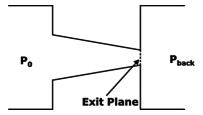
The figure shows a purely convergent nozzle with a steady, inviscid compressible flow of an ideal gas with constant thermophysical properties operating under choked condition. The exit plane shown in the figure is located within the nozzle. If the inlet pressure (P0) is increased while keeping the back pressure(Pback) unchanged, which of the following statements is/are true?
Correct Answer :
Solution :
The correct statements are:
1. Mach number at the exit plane of the nozzle will remain unchanged at unity
2. Mass flow rate through the nozzle will increase
Detailed Step-by-Step Explanation:
1. Behavior of the Mach Number at the Exit Plane:
The schematic in the first image shows a purely convergent nozzle where the inlet total pressure is labeled as
and the back pressure is labeled as
.
The Exit Plane (indicated by the dashed line and arrow) corresponds to the throat of the convergent nozzle, which is the minimum area section of the nozzle.
For a convergent nozzle, the maximum achievable Mach number at any point within the nozzle (including the exit plane) is unity:
Since the nozzle is operating under choked conditions, the flow velocity at the exit plane has already reached sonic speed, meaning the exit Mach number is exactly
.
Increasing the inlet stagnation pressure
while holding
constant will only increase the pressure ratio across the nozzle. It cannot make the flow supersonic at the exit of a convergent nozzle because expansion to supersonic speeds requires a divergent section. Hence, the Mach number at the exit plane remains unchanged at unity.
2. Behavior of the Mass Flow Rate:
As shown in the formula in the second image, the mass flow rate per unit area for a choked nozzle with an ideal gas under constant thermophysical properties is given by:
In this equation, is the throat (exit) area, is the ratio of specific heats, is the characteristic gas constant, and is the inlet stagnation temperature. Since the gas properties ( and ), the temperature , and the throat area are held constant, the choked mass flow rate is directly proportional to the inlet pressure :
Therefore, when the inlet pressure is increased, the mass flow rate through the nozzle will increase.
Access expert-curated educational resources and study materials—completely free.
Create, conduct, and manage professional online assessments with Crey. Perfect for teachers and institutes.
Copyright © 2026 Crey. All Rights Reserved.