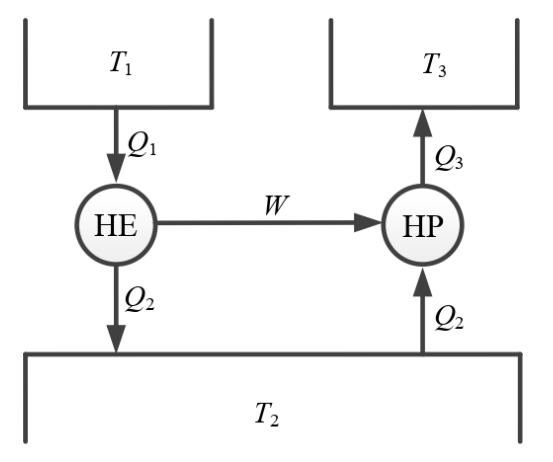
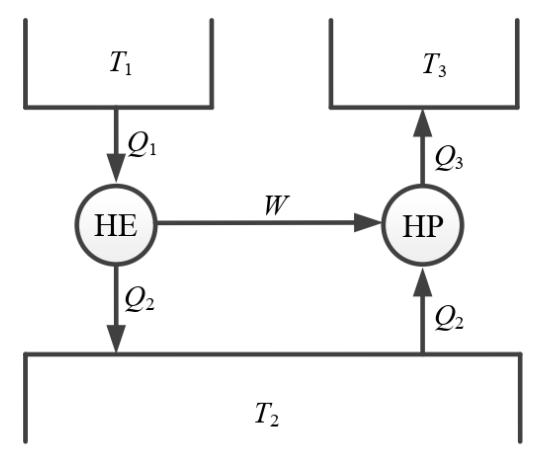
The figure shows a heat engine (HE) working between two reservoirs. The amount of heat (Q2) rejected by the heat engine is drawn by a heat pump (HP). The heat pump receives the entire work output (W) of the heat engine. If temperature, T1 > T3 > T2, then the relation between the efficiency (η) of the heat engine and the coefficient of performance (COP) of the heat pump is
Correct Answer :
COP= η-1
Solution :
Correct Answer:
The correct relation is: COP = η-1
Step-by-Step Explanation:
1. Understanding the Heat Engine (HE)
The heat engine operates between reservoirs to produce work output. Let the heat engine absorb heat from the high-temperature reservoir at , produce work output , and reject heat to the reservoir at .
By the first law of thermodynamics:
The thermal efficiency () of the heat engine is defined as the ratio of net work output to the heat input:
Taking the reciprocal of the efficiency expression:
2. Understanding the Heat Pump (HP)
The heat pump is driven by the entire work output () from the heat engine. It extracts the rejected heat from the reservoir at and delivers heat to the reservoir at .
Applying the first law of thermodynamics to the heat pump, the heat delivered is:
The coefficient of performance (COP) of the heat pump is defined as the desired heating effect divided by the work input:
3. Relating Efficiency and COP
By comparing the two derived equations, we can observe that:
This confirms that the coefficient of performance of the heat pump is the reciprocal of the efficiency of the heat engine.
Access expert-curated educational resources and study materials—completely free.
Create, conduct, and manage professional online assessments with Crey. Perfect for teachers and institutes.
Copyright © 2026 Crey. All Rights Reserved.