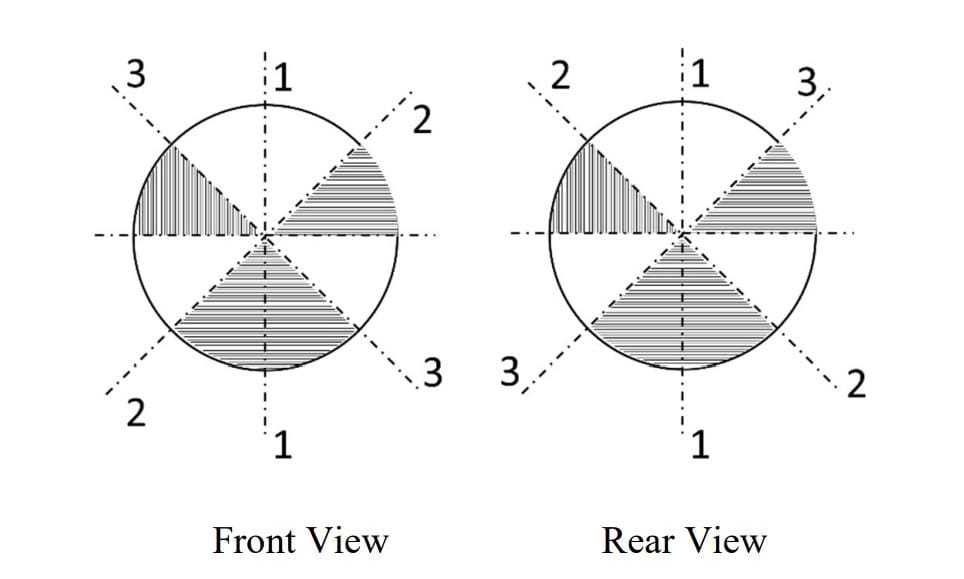
The figure below shows the front and rear view of a disc, which is shaded with identical patterns. The disc is flipped once with respect to any one of the fixed axes 1-1, 2-2 or 3-3 chosen uniformly at random. What is the probability that the disc DOES NOT retain the same front and rear views after the flipping operation?
Correct Answer :
2/3
Solution :
The correct option is 2/3.
Step-by-Step Explanation:
1. Understanding the Disc and its Shading Patterns:
By analyzing the provided image, we can identify the following features:
- The disc is divided into sectors by three fixed axes of symmetry: axis 1-1 (vertical), axis 2-2 (diagonal), and axis 3-3 (diagonal).
- In the Front View, the disc has:
- One vertically-shaded sector in the top-left quadrant (between the horizontal line and axis 3-3).
- One horizontally-shaded sector in the top-right quadrant (between the horizontal line and axis 2-2).
- One horizontally-shaded sector at the bottom (between axis 2-2 and axis 3-3).
- In the Rear View, the disc has:
- One vertically-shaded sector in the top-left quadrant (between the horizontal line and axis 2-2).
- One horizontally-shaded sector in the top-right quadrant (between the horizontal line and axis 3-3).
- One horizontally-shaded sector at the bottom (between axis 3-3 and axis 2-2).
2. Analyzing the Flipping Operation:
Flipping the disc 180° around any of the fixed axes interchanges the front and rear faces. For the disc to retain the same views, the resulting configuration after the flip must match the original front and rear views exactly (both in the positions of the shaded sectors and the orientation of their shading lines).
- Flipping around Axis 1-1 (Vertical Axis):
Flipping the disc around the vertical axis 1-1 mirrors the front pattern horizontally to the back, and the back pattern to the front. Since the vertically-shaded sector is on the left in the original front view, flipping it horizontally moves it to the right. Thus, the new front view will have the vertical shading on the right side, which does not match the original front view (where it is on the left). Therefore, the disc does not retain the same views after flipping around axis 1-1.
- Flipping around Axis 3-3:
Axis 3-3 passes through the top-left and bottom-right. The vertically-shaded sector (top-left) lies along this axis, but the horizontally-shaded sectors are not symmetric about this axis. A flip around axis 3-3 will map the horizontally-shaded sector to an unshaded region, which alters the front and rear views. Therefore, the disc does not retain the same views after flipping around axis 3-3.
- Flipping around Axis 2-2:
By checking the symmetry about axis 2-2, the reflection of the shaded sectors across this diagonal axis aligns perfectly with the original configuration of the opposite side. This is the only axis of rotation that preserves the overall shaded pattern and line orientations of both the front and rear views.
3. Calculating the Probability:
There are 3 possible axes to choose from: 1-1, 2-2, and 3-3.
- Number of flips that retain the same views = 1 (around axis 2-2).
- Number of flips that DO NOT retain the same views = 2 (around axes 1-1 and 3-3).
The probability P that the disc does not retain the same front and rear views is:
Access expert-curated educational resources and study materials—completely free.
Create, conduct, and manage professional online assessments with Crey. Perfect for teachers and institutes.
Copyright © 2026 Crey. All Rights Reserved.