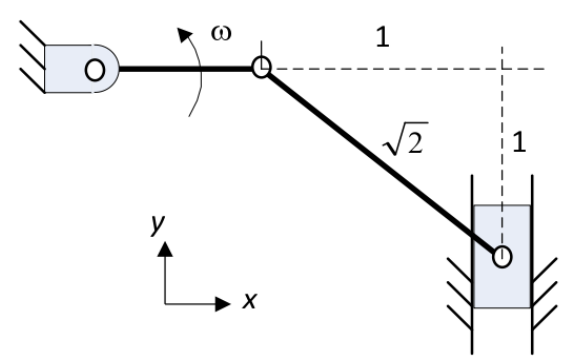
The crank of a slider-crank mechanism rotates counter-clockwise (CCW) with a constant angular velocity w, as shown. Assume the length of the crank to be r.
Using exact analysis, the acceleration of the slider in the y-direction, at the instant shown, where the crank is parallel to x-axis, is given by
Correct Answer :
ω²r
Solution :
The correct answer is:
ω²r
1. Define the Coordinate System:
Let us establish a Cartesian coordinate system with the crank's pivot O at the origin .
From the given diagram:
2. Mathematical Formulation:
Using the distance formula between the crank pin and the slider :
Substituting the expressions:
At the instant shown ():
Since the slider is located below the horizontal line of the crank pin, we select the negative root:
3. First Derivative (Velocity Analysis):
Differentiating the position relation with respect to time :
Dividing by 2 and substituting :
At and :
4. Second Derivative (Acceleration Analysis):
We differentiate the velocity equation with respect to time once more. Note that is constant, so :
Differentiating the first term :
At , this derivative simplifies to:
Differentiating the second term :
At , , and , this simplifies to:
Combining the terms of the differentiated equation:
Thus, the acceleration of the slider in the y-direction is exactly .
Access expert-curated educational resources and study materials—completely free.
Create, conduct, and manage professional online assessments with Crey. Perfect for teachers and institutes.
Copyright © 2026 Crey. All Rights Reserved.