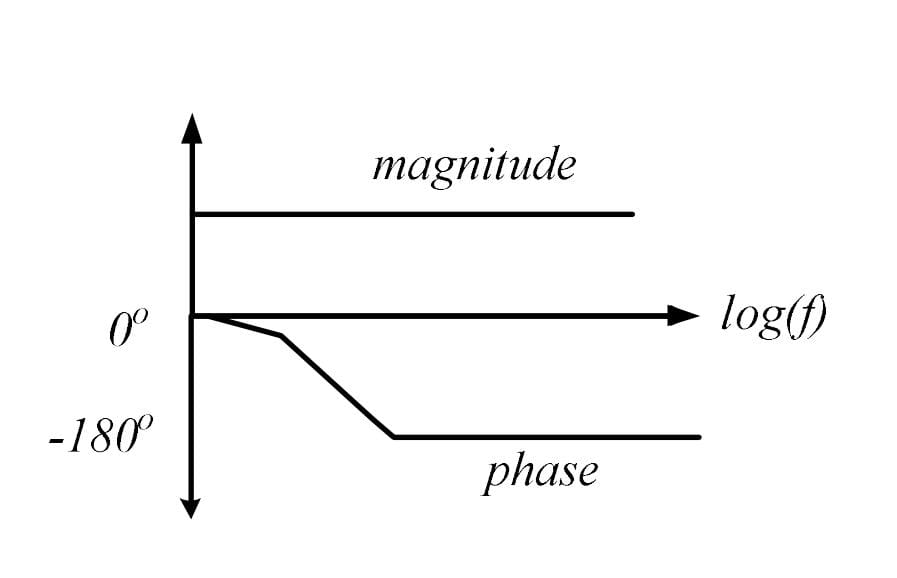
The Bode magnitude plot of a first order stable system is constant with frequency. The asymptotic value of the high frequency phase, for the system, is -180° This system has
Correct Answer :
one LHP pole and one RHP zero at the same frequency.
Solution :
The correct option is: one LHP pole and one RHP zero at the same frequency.
1. Analysis of the Bode Plot Image
By inspecting the provided image, we can observe two plots as a function of log-frequency, labeled on the horizontal axis as
- The upper curve, labeled "magnitude", is a flat horizontal line, indicating that the system's magnitude is constant across all frequencies.
- The lower curve, labeled "phase", starts at
and drops to a high-frequency asymptotic value of
as frequency increases.
2. System Stability
For a system to be stable, all of its poles must lie in the Left Half-Plane (LHP) of the s-domain. Therefore, a first-order stable system must have its pole at:
3. All-Pass Nature (Constant Magnitude)
A system that has a constant magnitude response across all frequencies is known as an all-pass system. For the magnitude to remain constant, the transfer function must satisfy:
This condition is fulfilled when the zeros of the system are the mirror reflections of its poles across the imaginary axis. Since the pole is at
(in the LHP), the zero must be located at
(in the Right Half-Plane, RHP) at the same frequency magnitude .
4. Transfer Function Derivation
Let us construct the transfer function with a pole at
and a zero at
with a gain adjustment for phase alignment:
Substituting
to obtain the frequency response:
5. Verifying Magnitude and Phase
The magnitude is:
This confirms the magnitude is indeed constant at all frequencies.
The phase of the transfer function is given by:
Now let's compute the phase at the frequency limits:
- At low frequency ():
- At high frequency ():
This perfectly matches the asymptotic phase values shown on the graph, confirming the presence of one stable LHP pole and one RHP zero at the same frequency.
Access expert-curated educational resources and study materials—completely free.
Create, conduct, and manage professional online assessments with Crey. Perfect for teachers and institutes.
Copyright © 2026 Crey. All Rights Reserved.