The 2 kg block shown in figure (top view) rests on a smooth horizontal surface and is attached to a massless elastic cord that has a stiffness 5 N/m.
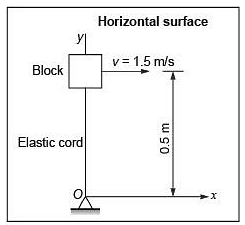
The cord hinged at O is initially unstretched and always remains elastic. The block is given a velocity v of 1.5 m/s perpendicular to the cord. The magnitude of velocity in m/s of the block at the instant the cord is stretched by 0.4 m is
Correct Answer :
Solution :
The correct option is 1.36.
1. Understanding the System and Given Data from the Image:
By analyzing the diagram, we can identify the following parameters:
• The pivot point O is located at the origin of the coordinate system .
• The massless elastic cord is initially unstretched and lies along the y-axis, connecting pivot O to the block. The initial unstretched length of the cord is , as indicated by the vertical dimension line on the coordinate plot.
• The mass of the block is:
• The stiffness (spring constant) of the elastic cord is:
• The initial velocity of the block is perpendicular to the cord in the horizontal plane:
• The stretch in the elastic cord at the final instant is:
2. Conservation of Mechanical Energy:
Since the horizontal surface is smooth (frictionless) and the elastic force is conservative, the total mechanical energy of the block-cord system is conserved between the initial state (State 1) and the final state (State 2):
The energy in State 1 consists only of kinetic energy, as the cord is initially unstretched:
The energy in State 2 consists of both kinetic energy and the elastic potential energy stored in the stretched cord:
where is the magnitude of the velocity at the final state.
3. Solving for the Final Velocity Magnitude:
Equating the initial and final energies:
Multiply the entire equation by 2:
Substitute the given values into the equation:
Simplify the terms:
Rearrange the equation to isolate the velocity term:
Taking the square root:
Thus, the magnitude of the velocity of the block at this instant is 1.36 m/s.
4. Analysis of Alternative Velocity Components (For Deeper Insight):
Since the only force on the block acts along the radial direction (towards the hinge O), the angular momentum of the block about O is also conserved:
• Conservation of Angular Momentum:
where , , and is the transverse velocity component.
• Radial Velocity Component:
Using the total velocity magnitude and the transverse component , we can compute the radial component :
The three options provided, 0.83, 1.07, and 1.36, correspond to the transverse velocity, radial velocity, and total velocity magnitude respectively. The question asks for the total velocity magnitude of the block, which is 1.36 m/s.
Access expert-curated educational resources and study materials—completely free.
Create, conduct, and manage professional online assessments with Crey. Perfect for teachers and institutes.
Copyright © 2026 Crey. All Rights Reserved.