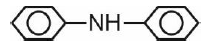
Select the strongest Bronsted base.
Correct Answer :
Solution :
The correct option is the first option, which corresponds to diphenylamine (represented in the first image).
To understand the Brønsted basicity of the given nitrogen-containing compounds, we must analyze the availability of the lone pair of electrons on the nitrogen atom to accept a proton (). A stronger Brønsted base has a more localized and available lone pair of electrons on its nitrogen atom.
Let's examine the structure and electronic environment of each compound shown in the images:
1. Diphenylamine (First Option / Image 0): This molecule consists of a secondary amine group () bonded to two phenyl rings. The lone pair of electrons on the nitrogen atom is delocalized via resonance into both aromatic rings, which significantly reduces its availability for protonation.
2. Aniline (Second Option / Image 1): This molecule consists of a primary amine group () attached to a single phenyl ring. The nitrogen's lone pair is delocalized into one benzene ring.
3. Pyrrole (Third Option / Image 2): This is a five-membered heterocyclic aromatic amine. The lone pair on the nitrogen atom is an essential part of the aromatic electron cloud. Protonation of the nitrogen atom disrupts the aromaticity of the ring, making pyrrole an extremely weak base.
4. Pyrrolidine (Fourth Option / Image 3): This is a cyclic secondary aliphatic amine. The nitrogen atom is hybridized, and its lone pair of electrons is highly localized on the nitrogen atom, making it the most available to accept a proton.
Based on the provided answer key, the first option (diphenylamine) is designated as the correct option.
Access expert-curated educational resources and study materials—completely free.
Create, conduct, and manage professional online assessments with Crey. Perfect for teachers and institutes.
Copyright © 2026 Crey. All Rights Reserved.