Select the option that gives the correct description of the process of Natural Selection with respect to the length of the neck of giraffe.
Correct Answer :
Solution :
Correct Options:
1. Directional selection as giraffes with longer neck lengths are selected.
2. Stabilising selection as giraffes with medium neck lengths are selected.
Analysis of the Graph:
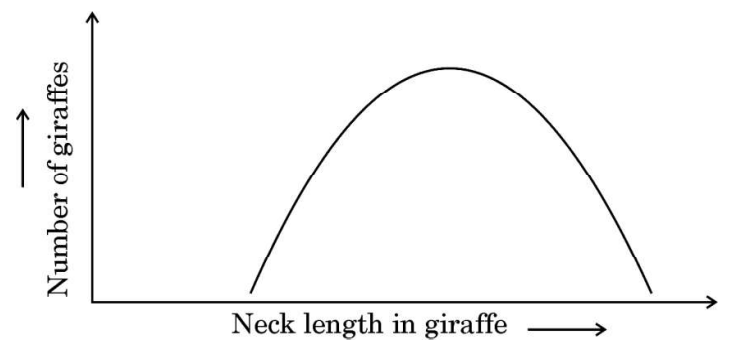
The provided image shows a graph representing the distribution of a trait in a population:
• The y-axis is labeled "Number of giraffes", which represents the frequency of individuals in the population.
• The x-axis is labeled "Neck length in giraffe", representing the phenotypic variation of neck lengths from shorter (on the left) to longer (on the right).
• The curve is a standard bell-shaped normal distribution curve, showing that most individuals in the initial population have intermediate (medium) neck lengths, while fewer individuals have extremely short or extremely long necks.
Explanation of the Selective Processes:
Natural selection can act on this phenotypic distribution in different ways depending on environmental pressures:
1. Directional Selection:
Directional selection occurs when environmental changes favor individuals at one extreme of the phenotypic range. In the case of giraffes, if tall trees become the primary source of food due to the depletion of lower-level vegetation, giraffes with longer necks will have a survival and reproductive advantage. Over generations, selection favors the extreme phenotype (longer necks), causing the peak of the distribution curve to shift progressively toward the right (longer neck length). Hence, directional selection operates when giraffes with longer neck lengths are selected.
2. Stabilising Selection:
Stabilising selection occurs when environmental conditions are stable, favoring the average or intermediate phenotype (medium neck length) while selecting against both extremes (very short and very long necks). Extremely short necks make it difficult to reach food, whereas extremely long necks may introduce physiological, cardiovascular, or structural burdens. Under these stable conditions, selection favors the medium neck length, which keeps the population mean stable and narrows the width of the bell curve. Thus, stabilising selection operates when giraffes with medium neck lengths are selected.
Access expert-curated educational resources and study materials—completely free.
Create, conduct, and manage professional online assessments with Crey. Perfect for teachers and institutes.
Copyright © 2026 Crey. All Rights Reserved.
 Set - 3-1782888548748.webp)