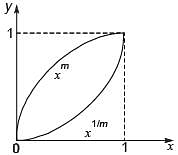
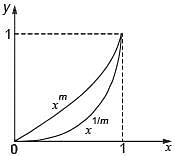
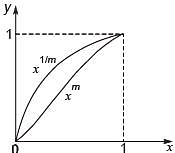
Select the graph that schematically represents BOTH y = x^m and y = x^1/m properly in the interval 0 ≤ x ≤ 1. For integer values of m, where m > 1
Correct Answer :
Solution :
Correct Answer/Option:
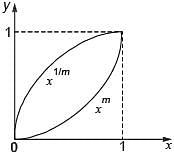
The correct option is the first option, which corresponds to the image dj6466-1721300611764.jpg.
Detailed Step-by-Step Explanation:
We are asked to identify the graph that schematically represents both curves:
and
properly in the interval:
for integer values of where .
Let's analyze the properties of these two functions within the given interval step-by-step:
1. Coordinates of the Endpoints
At the lower boundary :
and
Thus, both curves start at the origin .
At the upper boundary :
and
Thus, both curves terminate at the point .
2. Comparing Values in the Open Interval
Since is an integer, for any value of strictly between and :
- Multiplying by itself times reduces the value, so .
- Taking the -th root of increases the value, so .
This gives the relation:
Therefore, the graph of the curve must lie entirely above the line of identity , while the graph of the curve must lie entirely below it.
3. Slope and Curvature at the Origin
Let us evaluate the derivatives to determine the slopes at the origin:
- For the lower curve:
Since , at , the derivative is:
This means starts with a flat horizontal tangent at the origin and curves upward (concave up).
- For the upper curve:
Since , as , the denominator approaches 0, meaning:
This means starts with a vertical tangent at the origin and curves downward (concave down).
4. Symmetry and Inverse Functions
The two functions are mathematical inverses of each other in the domain . Thus, their graphs are perfectly symmetric reflections of each other across the diagonal line .
Conclusion:
In the correct graph (Option 1, corresponding to the image dj6466-1721300611764.jpg):
- The horizontal axis is going from to , and the vertical axis is going from to .
- The upper curve (rising vertically at the start, concave down) is correctly labeled as .
- The lower curve (starting horizontally flat, concave up) is correctly labeled as .
Access expert-curated educational resources and study materials—completely free.
Create, conduct, and manage professional online assessments with Crey. Perfect for teachers and institutes.
Copyright © 2026 Crey. All Rights Reserved.