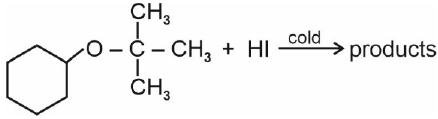
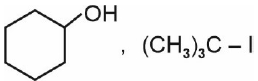
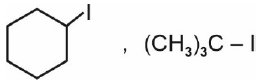
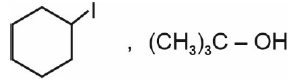
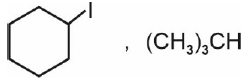
Products are
Correct Answer :
Solution :
The correct option is the one showing cyclohexanol and tert-butyl iodide (represented as a cyclohexane ring with a hydroxyl group, and ).
Step-by-step Explanation:
1. Understanding the Reactants:
The starting material shown in the question is cyclohexyl tert-butyl ether, which is an unsymmetrical ether. In this molecule, the oxygen atom is connected to:
- A secondary alkyl group (cyclohexyl ring)
- A tertiary alkyl group (tert-butyl group, )
2. Protonation of the Ether:
When treated with a strong acid like cold hydroiodic acid (), the lone pairs on the ether oxygen atom abstract a proton () from to form a protonated ether (oxonium ion intermediate):
3. Determining the Mechanism (SN1 vs SN2):
- Generally, the reaction of unsymmetrical ethers with cold occurs via an SN2 pathway, where the iodide nucleophile () attacks the less sterically hindered carbon atom.
- However, if one of the alkyl groups attached to the ether oxygen is a tertiary alkyl group (such as the tert-butyl group), the reaction mechanism shifts to an SN1 pathway.
- This shift occurs because the tertiary C-O bond can easily cleave to generate an exceptionally stable tert-butyl carbocation ().
4. Cleavage and Carbocation Formation:
The protonated ether undergoes heterolytic cleavage at the C-O bond connecting the oxygen and the tert-butyl group:
This leaves behind cyclohexanol as the alcohol product.
5. Nucleophilic Attack:
The remaining iodide ion () rapidly attacks the highly reactive tert-butyl carbocation to form the halide product, tert-butyl iodide:
Therefore, the final products of this reaction are cyclohexanol and tert-butyl iodide.
Access expert-curated educational resources and study materials—completely free.
Create, conduct, and manage professional online assessments with Crey. Perfect for teachers and institutes.
Copyright © 2026 Crey. All Rights Reserved.