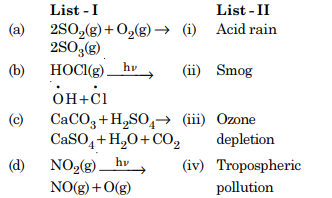
Match List - I with List - II.
Choose the correfct answer from the options given below.
Correct Answer :
Solution :
The correct option is (a)-(iv), (b)-(iii), (c)-(i), (d)-(ii).
Let us analyze the chemical reactions given in List - I and match them with the atmospheric phenomena in List - II step-by-step:
1. Matching (a) to (iv):
Reaction (a):
This reaction represents the oxidation of sulfur dioxide () to sulfur trioxide () in the troposphere. Sulfur oxides are major air pollutants emitted by burning fossil fuels. This process is a primary contributor to Tropospheric pollution. Therefore, (a) matches with (iv).
2. Matching (b) to (iii):
Reaction (b):
In the stratosphere, hypochlorous acid () undergoes photolysis (dissociation by sunlight, ) to form hydroxyl () and chlorine () free radicals. The chlorine radical () plays a catalytic role in the breakdown of ozone, leading to Ozone depletion. Therefore, (b) matches with (iii).
3. Matching (c) to (i):
Reaction (c):
This reaction shows calcium carbonate (such as marble and limestone in buildings and monuments) reacting with sulfuric acid (). This is the classic reaction depicting the damage caused by Acid rain (which contains sulfuric acid) to historical monuments like the Taj Mahal. Therefore, (c) matches with (i).
4. Matching (d) to (ii):
Reaction (d):
Under the influence of sunlight (), nitrogen dioxide () photolyzes in the troposphere to yield nitric oxide () and highly reactive atomic oxygen (). This atomic oxygen subsequently combines with molecular oxygen to produce ozone, initiating the chain reactions that generate photochemical Smog. Therefore, (d) matches with (ii).
Access expert-curated educational resources and study materials—completely free.
Create, conduct, and manage professional online assessments with Crey. Perfect for teachers and institutes.
Copyright © 2026 Crey. All Rights Reserved.