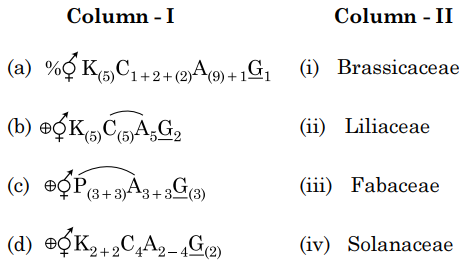
Match Column - I with Column - II and choose the correct answer.
Correct Answer :
Solution :
To find the correct match, let us analyze the floral formulas provided in Column - I and relate them to the plant families in Column - II:
(a) matches with (iii) Fabaceae:
- indicates a zygomorphic (bilaterally symmetrical) flower.
- indicates a bisexual flower.
- indicates 5 fused sepals (gamosepalous).
- represents a papilionaceous corolla with 5 petals (1 standard, 2 lateral wings, and 2 fused keel petals).
- represents diadelphous stamens (9 fused in a bundle and 1 free).
- represents a monocarpellary superior ovary.
Therefore, a - (iii).
(b) matches with (iv) Solanaceae:
- indicates an actinomorphic (radially symmetrical) flower.
- and indicate fused sepals and fused petals (gamopetalous) respectively.
- The arc connecting Corolla (C) and Androecium (A) represents epipetalous stamens (stamens attached to the petals).
- indicates a bicarpellary, syncarpous, superior ovary.
Therefore, b - (iv).
(c) matches with (ii) Liliaceae:
- indicates a perianth composed of 6 tepals arranged in two whorls of 3, which are fused.
- The arc connecting Perianth (P) and Androecium (A) represents epiphyllous stamens (stamens attached to the tepals).
- indicates a tricarpellary, syncarpous, superior ovary.
Therefore, c - (ii).
(d) matches with (i) Brassicaceae:
- indicates 4 sepals arranged in two whorls of 2.
- indicates 4 free petals arranged in a cruciform (cross-like) pattern.
- indicates tetradynamous stamens (6 stamens total: 2 outer short stamens and 4 inner long stamens).
- indicates a bicarpellary, syncarpous, superior ovary.
Therefore, d - (i).
Combining all the matched pairs, we get:
a - (iii), b - (iv), c - (ii), d - (i)
Access expert-curated educational resources and study materials—completely free.
Create, conduct, and manage professional online assessments with Crey. Perfect for teachers and institutes.
Copyright © 2026 Crey. All Rights Reserved.
 Set - 3-1782888548748.webp)