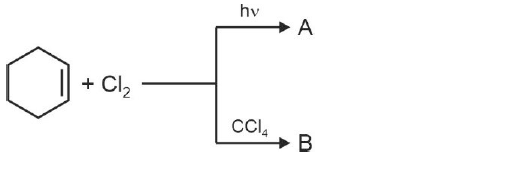
In the following reactions, find the product A and B?
Correct Answer :
Solution :
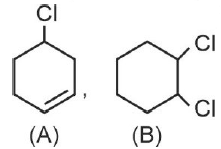
The correct answer is the option showing (A) as 3-chlorocyclohexene and (B) as 1,2-dichlorocyclohexane.
Step-by-step Explanation:
1. Formation of Product A (Allylic Substitution):
When cyclohexene is treated with chlorine gas () in the presence of light () or heat, a free-radical substitution reaction takes place rather than addition.
- The light or heat causes homolytic cleavage of the chlorine-chlorine bond to generate chlorine free radicals ().
- The chlorine radical abstracts a hydrogen atom from the allylic position (the carbon atom adjacent to the double bond, ) of cyclohexene. This is because the allylic C-H bond is weaker, and the resulting allylic radical is highly stable due to resonance delocalization.
- The allylic radical then reacts with another chlorine molecule to form 3-chlorocyclohexene (Product A) and regenerates a chlorine radical.
Therefore, Product A is 3-chlorocyclohexene.
2. Formation of Product B (Electrophilic Addition):
When cyclohexene reacts with chlorine () in a non-polar solvent like carbon tetrachloride () in the dark/room temperature, electrophilic addition occurs across the double bond.
- The pi () electrons of the double bond attack the chlorine molecule, displacing a chloride ion () and forming a cyclic chloronium ion intermediate.
- The chloride ion () then attacks one of the carbons of the three-membered chloronium ring from the backside (anti-addition) to open the ring.
- This yields 1,2-dichlorocyclohexane (specifically the trans isomer) where the double bond is saturated.
Therefore, Product B is 1,2-dichlorocyclohexane.
By comparing the options:
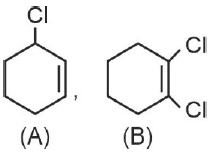
- Option 1 shows Product B with a double bond (incorrect addition product).
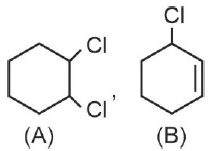
- Option 3 has the products swapped (A is the addition product and B is the substitution product).
- Option 4 correctly shows Product A as 3-chlorocyclohexene (substitution at the allylic carbon) and Product B as 1,2-dichlorocyclohexane (addition product with saturated ring).
Access expert-curated educational resources and study materials—completely free.
Create, conduct, and manage professional online assessments with Crey. Perfect for teachers and institutes.
Copyright © 2026 Crey. All Rights Reserved.