Correct Answer :
Solution :
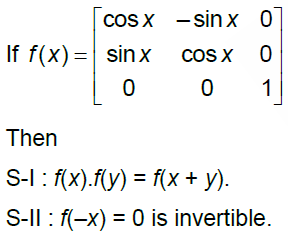
The correct option is S-I True, S-II True.
Let us analyze the given matrix-valued function:
Step 1: Evaluation of Statement-I (S-I)
We need to check if is true.
Let us find the product of and :
Performing row-by-column multiplication, we get:
Using standard trigonometric identity formulas:
1.
2.
3.
Substituting these identities back into the matrix, we get:
Therefore, Statement-I (S-I) is True.
Step 2: Evaluation of Statement-II (S-II)
We need to verify if is invertible.
Let us find the matrix by substituting in place of :
Since and , we have:
Now, let us calculate the determinant of :
Expanding along the third column:
Evaluating this 2×2 determinant:
Since the determinant , the matrix is non-singular and therefore invertible.
Thus, Statement-II (S-II) is also True.
Access expert-curated educational resources and study materials—completely free.
Create, conduct, and manage professional online assessments with Crey. Perfect for teachers and institutes.
Copyright © 2026 Crey. All Rights Reserved.