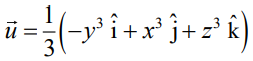
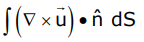
Given a vector  and ˆn as the unit
normal vector to the surface of the hemisphere
(x²
+ y²
+ z²
= 1;z ≥0), the value of integral
and ˆn as the unit
normal vector to the surface of the hemisphere
(x²
+ y²
+ z²
= 1;z ≥0), the value of integral  evaluated on the curved surface
of the hemisphere S is
evaluated on the curved surface
of the hemisphere S is
Correct Answer :
π/2
Solution :
Correct Answer:
1. Understanding the Problem and Stokes' Theorem
We are given a vector field:
We want to evaluate the surface integral:
where is the curved surface of the hemisphere defined by:
and is the unit outward normal vector to the curved surface .
By applying Stokes' Theorem (as shown in the formula in the second attached image):
where is the boundary curve enclosing the hemisphere. The boundary of this hemisphere (depicted in the first attached image) is a circle lying in the -plane where .
2. Simplifying the Line Integral
The boundary curve is the unit circle in the -plane:
Since along the curve , we have .
Substituting and into the line integral:
Setting and (as visible in the third attached image):
3. Applying Green's Theorem
We can convert the line integral over the closed curve to a double integral over the region (the region enclosed by the circle in the -plane) using Green's Theorem:
Here, our components are:
Taking the partial derivatives:
Substituting these into the formula:
Therefore, the double integral over the disk becomes:
4. Evaluating in Polar Coordinates
To evaluate this integral, we convert to polar coordinates:
For the unit disk , the limits of integration are:
Substituting these into the integral (as shown in the fourth attached image):
First, integrate with respect to :
Next, integrate with respect to :
Access expert-curated educational resources and study materials—completely free.
Create, conduct, and manage professional online assessments with Crey. Perfect for teachers and institutes.
Copyright © 2026 Crey. All Rights Reserved.