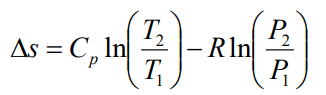
For an ideal gas with constant properties undergoing a quasi-static process, which one of the following represents the change of entropy (∆s) from state 1 to 2?
Correct Answer :
Solution :
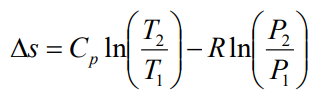
The correct answer/option is represented by the formula shown in the first option:
Image Analysis and Context:
By inspecting the provided images, we identify the expressions as follows:
- Image 0 (the correct option) displays the formula: .
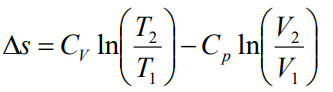
- Image 1 displays the incorrect relation: .
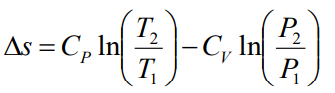
- Image 2 displays the incorrect relation: .
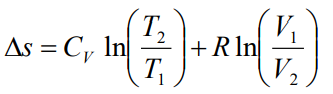
- Image 3 displays: .
- Image 4 lists three relations, with the third one confirming the correct entropy change expression.
Step-by-Step Derivation:
We begin with the fundamental Gibbs relation (commonly known as the second relation) for a simple compressible system:
where:
For an ideal gas, we can express the specific enthalpy change () and specific volume () using standard ideal gas properties:
1. The definition of specific heat capacity at constant pressure () yields:
2. From the ideal gas equation of state (), specific volume is:
where is the specific gas constant.
Substituting these expressions back into the equation:
Dividing the entire equation by the absolute temperature isolates the change in specific entropy:
To find the total change in specific entropy () between state 1 and state 2, we integrate both sides. Since the gas properties (such as and ) are constant:
Carrying out the integrations yields:
Applying the boundaries and the logarithmic subtraction property ():
This successfully derives the exact expression visible in the correct option.
Access expert-curated educational resources and study materials—completely free.
Create, conduct, and manage professional online assessments with Crey. Perfect for teachers and institutes.
Copyright © 2026 Crey. All Rights Reserved.