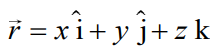
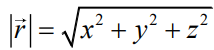
For a position vector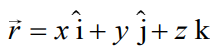 the norm of the vector can be defined as
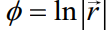
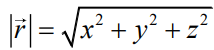 . Given a function
,
. Given a function
, 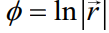 its gradient
 is
is
Correct Answer :
Solution :
The correct option is:
Step-by-Step Derivation:
1. We are given the position vector from the image:
The norm (or magnitude) of this vector is:
2. We are given the function:
Using logarithmic properties, we can rewrite the square root power of 1/2 as a coefficient:
3. The gradient of the scalar function is defined as:
4. Calculate the partial derivative with respect to using the chain rule:
By symmetry, the partial derivatives with respect to and are:
5. Substitute the partial derivatives back into the gradient formula:
Combine the terms under a single common denominator:
6. Simplify using vector notations:
The numerator is the position vector itself:
The denominator is the square of the magnitude of , which is equivalent to the dot product of with itself:
Substituting these expressions gives the final result:
Access expert-curated educational resources and study materials—completely free.
Create, conduct, and manage professional online assessments with Crey. Perfect for teachers and institutes.
Copyright © 2026 Crey. All Rights Reserved.