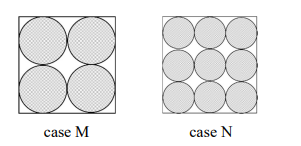
Equal sized circular regions are shaded in a square sheet of paper of 1 cm side length. Two cases, case M and case N, are considered as shown in the figures below. In the case M, four circles are shaded in the square sheet and in the case N, nine circles are shaded in the square sheet as shown. What is the ratio of the areas of unshaded regions of case M to that of case N?
Correct Answer :
Solution :
Correct Answer: The correct option is 1:1.
Step-by-Step Explanation:
Let the side length of the square sheet of paper be in both cases.
The total area of the square sheet is:
1. Analysis of Case M:
As observed in the diagram under the label "case M", there are 4 identical shaded circles arranged in a grid inside the square sheet.
Since two circles fit exactly along one side of the square (which is long), the diameter of each circle in Case M is:
The radius () of each circle is:
The area of a single circle in Case M is:
Therefore, the total area of the 4 shaded circles in Case M is:
The area of the unshaded region in Case M is:
2. Analysis of Case N:
As observed in the diagram under the label "case N", there are 9 identical shaded circles arranged in a grid inside the square sheet.
Since three circles fit exactly along one side of the square, the diameter of each circle in Case N is:
The radius () of each circle is:
The area of a single circle in Case N is:
Therefore, the total area of the 9 shaded circles in Case N is:
The area of the unshaded region in Case N is:
3. Determining the Ratio:
Comparing the two cases, we see that the total shaded area is identical in both cases, which means the unshaded area is also identical in both cases. Let us calculate the ratio:
This simplified ratio translates directly to 1:1.
Access expert-curated educational resources and study materials—completely free.
Create, conduct, and manage professional online assessments with Crey. Perfect for teachers and institutes.
Copyright © 2026 Crey. All Rights Reserved.