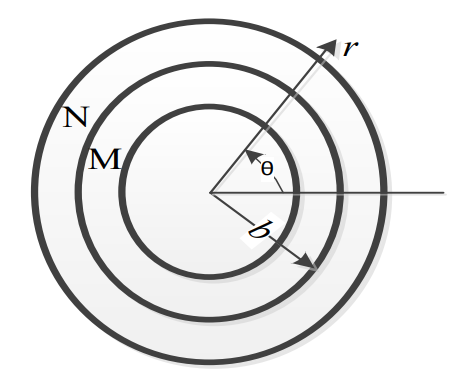
Consider two concentric circular cylinders of different materials M and N in contact with each other at r = b, as shown below. The interface at r = b is frictionless. The composite cylinder system is subjected to internal pressure P. Let (urM ,uθM) and (σrrM σθθM) denote the radial and tangential displacement and stress components, respectively, in material M. Similarly, (urN ,uθN) and (σrrN σθθN) denote the radial and tangential displacement and stress components, respectively, in material N. The boundary conditions that need to be satisfied at the frictionless interface between the two cylinders are :
Correct Answer :
urM = urN and σrrM= σrrN only
Solution :
The correct answer is:
urM = urN and σrrM = σrrN only
Problem Analysis:
As shown in the provided schematic image, the composite system consists of two concentric cylinders made of different materials, M (inner cylinder) and N (outer cylinder), which are in contact at the interface radius:
The system is subjected to an internal pressure P. We are tasked with identifying the boundary conditions that must hold at this interface. Let's analyze each condition step-by-step based on mechanical principles:
1. Continuity of Radial Displacement (Kinematic Boundary Condition):
Since the two cylinders remain in contact during deformation without separation or interpenetration at the interface, the radial displacement of the outer boundary of cylinder M must equal the radial displacement of the inner boundary of cylinder N at the contact radius:
2. Continuity of Radial Stress (Static Boundary Condition):
For static equilibrium at the contact surface, the action and reaction forces in the radial direction must be equal and opposite. This requires that the normal stress (radial stress) be continuous across the interface:
3. Impact of the Frictionless Interface:
The problem states that the interface at
is frictionless.
- A frictionless interface cannot transmit shear stresses. Therefore, the shear stresses on both sides must vanish:
- Because the interface is frictionless, the two cylinders are free to slide relative to one another in the circumferential (tangential) direction. Consequently, their tangential displacements do not have to be equal:
- Furthermore, since cylinders M and N are made of different materials with different elastic properties (such as Young's modulus and Poisson's ratio), their circumferential expansion under radial loading differs, meaning the tangential (hoop) stresses are discontinuous across the interface:
Conclusion:
Thus, the only conditions that must be satisfied at the frictionless interface at
are:
Access expert-curated educational resources and study materials—completely free.
Create, conduct, and manage professional online assessments with Crey. Perfect for teachers and institutes.
Copyright © 2026 Crey. All Rights Reserved.