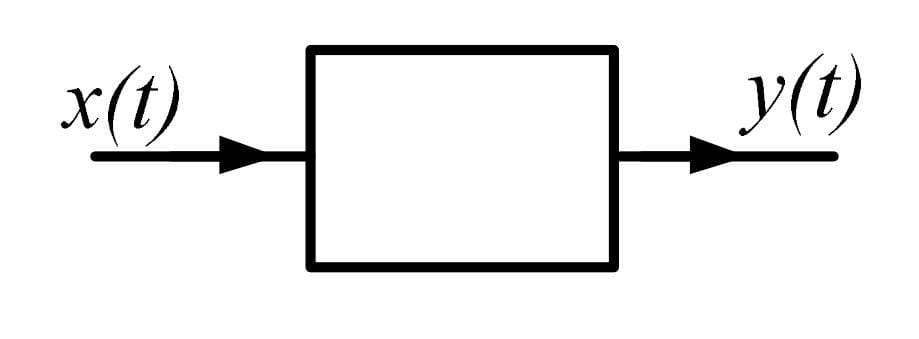
Consider the system as shown below
where, y(t)=x(et). The system is
Correct Answer :
linear and non-causal.
Solution :
The correct option is: linear and non-causal.
We are given a system with input
and output
represented by the block diagram in the image, where the system relationship is defined as:
To determine the properties of the system, we analyze its linearity and causality.
1. Linearity Analysis:
A system is linear if it satisfies the properties of superposition and homogeneity. Let's test these properties by applying a linear combination of two arbitrary inputs,
and
.
Let:
Now, consider a new input
which is a linear combination of the two inputs with constants
and
:
The response of the system to this combined input is:
Substituting the expression for
:
Since the system response to the weighted sum of inputs is equal to the weighted sum of individual responses, the system is linear.
2. Causality Analysis:
A system is causal if its output at any time
depends only on the values of the input at the current time
and/or past times (i.e., for values of the input at
).
Let us evaluate the system output at a specific time instance, for example,
:
Here, the output at the present time
depends on the future value of the input signal at
.
Because the output depends on future values of the input for
, the system is non-causal.
Conclusion:
Thus, the system is both linear and non-causal.
Access expert-curated educational resources and study materials—completely free.
Create, conduct, and manage professional online assessments with Crey. Perfect for teachers and institutes.
Copyright © 2026 Crey. All Rights Reserved.