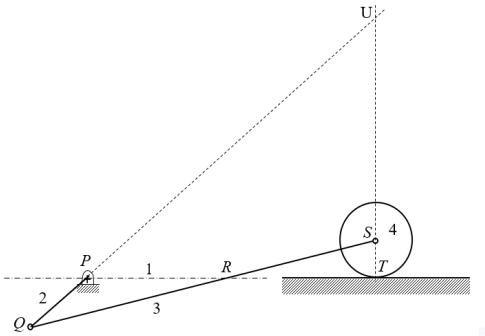
Consider the mechanism shown in the figure. There is rolling contact without slip between the disc and ground.
Select the correct statement about instantaneous centers in the mechanism.
Correct Answer :
Solution :
The correct option is: All points P, Q, R, S, T and U are instantaneous centers of mechanism
1. Identification of Links and Joint Locations:
From the given mechanism diagram, we can identify four distinct links:
• Link 1: The ground/frame (represented by the horizontal dash-dot line passing through pivot P and the hatched ground surface).
• Link 2: The crank link pivoted to the ground at point P.
• Link 3: The connecting rod joining point Q and the center of the disc at point S.
• Link 4: The circular disc of radius ST rolling on the ground.
2. Calculating the Total Number of Instantaneous Centers:
For a planar mechanism with N links, the total number of instantaneous centers () is given by the formula:
Substituting into the formula:
Thus, there are exactly 6 instantaneous centers for this mechanism: , , , , , and .
3. Determining the Location of Each Instantaneous Center:
We can locate all 6 instantaneous centers using direct observation and the Aronhold-Kennedy Theorem of Three Centers (which states that if three links move relatively to each other, their three relative instantaneous centers must lie on a straight line):
• Center (Point P): This is the permanent pin joint connecting the crank (Link 2) to the fixed ground (Link 1). Therefore, point P is the instantaneous center .
• Center (Point Q): This is the pin joint connecting the crank (Link 2) and the connecting rod (Link 3). Therefore, point Q is the instantaneous center .
• Center (Point S): This is the pin joint connecting the connecting rod (Link 3) to the center of the disc (Link 4). Therefore, point S is the instantaneous center .
• Center (Point T): Since the disc (Link 4) rolls without slipping on the ground (Link 1), the point of contact T has zero instantaneous velocity relative to the ground. Thus, point T is the instantaneous center .
• Center (Point U): According to Kennedy's Theorem, the three centers , , and must lie on a straight line (line PQ). Similarly, the three centers , , and must lie on a straight line (vertical line TS through the disc's center). The intersection of the extension of line PQ and the vertical line TS locates the instantaneous center , which is labeled as point U.
• Center (Point R): By Kennedy's Theorem, the three centers , , and must lie on a straight line (the horizontal line of centers/ground line PT). Additionally, the three centers , , and must lie on a straight line (line QS along Link 3). The intersection of the horizontal line PT and the link axis line QS defines the instantaneous center , which is labeled as point R.
Conclusion:
Since all six points P, Q, R, S, T, and U correspond exactly to the six instantaneous centers of this four-link mechanism, all of these points are instantaneous centers.
Access expert-curated educational resources and study materials—completely free.
Create, conduct, and manage professional online assessments with Crey. Perfect for teachers and institutes.
Copyright © 2026 Crey. All Rights Reserved.