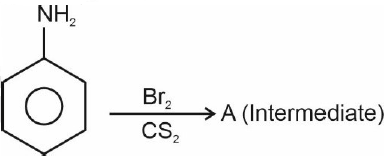
Consider the following reaction.
Correct Answer :
Solution :
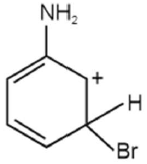
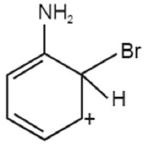
The correct option is the second image, which represents the carbocation intermediate (-complex or Wheland intermediate) formed during the electrophilic attack of bromine at the ortho-position of aniline.
In aniline, the amino group:
is a strongly activating and ortho/para-directing group. The nitrogen atom has a lone pair of electrons that can be donated into the benzene ring through resonance (+M effect). This increases the electron density specifically at the ortho and para positions, making these positions highly nucleophilic and reactive towards electrophiles.
When aniline reacts with bromine:
in a non-polar solvent like carbon disulfide () at a low temperature, monobromination occurs. The electrophile generated is the bromonium ion:
Due to the directing effect of the amino group, the electrophilic attack occurs at either the ortho or para position.
When the electrophile attacks the ortho-position (carbon-2 adjacent to the amino group), it forms the corresponding resonance-stabilized carbocation intermediate. In this intermediate, the ortho-carbon becomes sp3 hybridized and is bonded to both a hydrogen atom and a bromine atom. This matches the structure shown in the second image (Image 2), where the positive charge is located on the adjacent carbon atom within the ring.
The first image (Image 1) shows the intermediate that would result from an attack at the meta-position. Because the amino group is ortho/para-directing, attack at the meta-position does not occur, making the intermediate in the first image incorrect.
Access expert-curated educational resources and study materials—completely free.
Create, conduct, and manage professional online assessments with Crey. Perfect for teachers and institutes.
Copyright © 2026 Crey. All Rights Reserved.