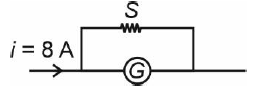
Consider the circuit shown. Galvanometer resistance is 10 Ω and current through galvanometer is 3 mA. Find the resistance of shunt.
Correct Answer :
3.75 × 10⁻³ Ω
Solution :
The correct option is 3.75 × 10⁻³ Ω.
1. Understanding the Circuit from the Diagram:
From the given circuit diagram, we can observe that a total current labeled as
enters the junction. The circuit then splits into two parallel branches:
- The upper branch contains a shunt resistor with resistance
.
- The lower branch contains a galvanometer with resistance
.
2. Identifying the Given Parameters:
- Galvanometer resistance,
- Current through the galvanometer,
- Total current,
3. Formulation:
In a parallel combination, the potential difference (voltage) across the shunt resistor is equal to the potential difference across the galvanometer:
where
is the current flowing through the shunt resistor. By Kirchhoff's Current Law, the remaining current flows through the shunt:
Substituting this expression into the voltage equation gives:
Rearranging the equation to solve for the shunt resistance
:
4. Step-by-Step Calculation:
Substitute the values into the formula:
Simplify the numerator and the denominator:
Access expert-curated educational resources and study materials—completely free.
Create, conduct, and manage professional online assessments with Crey. Perfect for teachers and institutes.
Copyright © 2026 Crey. All Rights Reserved.