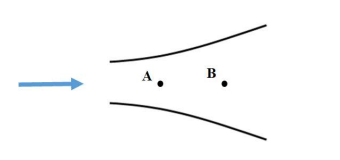
Consider a steady flow through a horizontal divergent channel, as shown in the figure, with supersonic flow at the inlet. The direction of flow is from left to right. Pressure at location B is observed to be higher than that at an upstream location A. Which among the following options can be the reason?
Correct Answer :
Solution :
Correct Answer: Normal shock
Step-by-Step Explanation:
1. Understanding the Channel Geometry and Flow Direction
The provided image shows a horizontal diverging channel where the cross-sectional area increases from left to right (in the direction of the flow indicated by the blue arrow). Point A is located upstream, and Point B is located downstream. The flow entering the inlet of the channel is supersonic, meaning the inlet Mach number is greater than 1.
2. Isentropic Supersonic Flow Behavior
For steady, one-dimensional, isentropic compressible flow, the relation between the change in area and the change in velocity is given by the area-velocity relation:
where:
• is the cross-sectional area,
• is the flow velocity,
• is the Mach number.
For supersonic flow, the Mach number is greater than one:
Consequently, the term is positive. Since the channel is diverging, the change in area is positive (). To satisfy the area-velocity equation, the change in velocity must also be positive (). This means that under normal isentropic conditions, supersonic flow in a diverging nozzle continues to accelerate, and the Mach number increases downstream.
As the velocity increases, the static pressure must decrease downstream to maintain conservation of energy. Therefore, in isentropic supersonic flow, the pressure at downstream location B () would normally be lower than the pressure at upstream location A ():
3. The Effect of a Normal Shock
However, the problem states that the pressure at B is observed to be higher than that at A (). This indicates a non-isentropic process that causes compression instead of expansion.
A normal shock is a very thin, abrupt discontinuity that can occur in supersonic flows. When a normal shock wave forms in the diverging channel between location A and location B, the flow properties change drastically across the shock:
• The flow velocity abruptly drops from supersonic () to subsonic ().
• There is a sudden, sharp rise in static pressure, density, and temperature across the shock wave.
Because of this sudden compression across the shock, the static pressure at downstream location B becomes significantly higher than the pressure at upstream location A. Thus, the presence of a normal shock between A and B is the correct physical explanation for the observed pressure rise.
Access expert-curated educational resources and study materials—completely free.
Create, conduct, and manage professional online assessments with Crey. Perfect for teachers and institutes.
Copyright © 2026 Crey. All Rights Reserved.