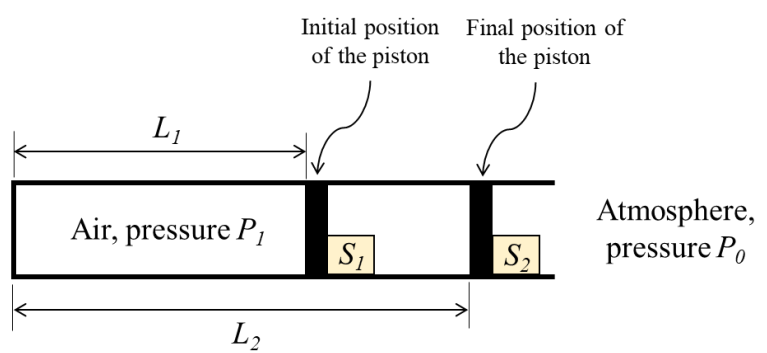
Consider a fully adiabatic piston-cylinder arrangement as shown in the figure. The piston is massless and cross-sectional area of the cylinder is 𝐴. The fluid inside the cylinder is air (considered as a perfect gas), with γ being the ratio of the specific heat at constant pressure to the specific heat at constant volume for air. The piston is initially located at a position 𝐿1. The initial pressure of the air inside the cylinder is 𝑃1 ≫ 𝑃0, where 𝑃0 is the atmospheric pressure. The stop S1 is instantaneously removed and the piston moves to the position 𝐿2, where the equilibrium pressure of air inside the cylinder is 𝑃2 ≫ 𝑃0.
What is the work done by the piston on the atmosphere during this process?
Correct Answer :
𝑃0𝐴(𝐿2 − 𝐿1 )
Solution :
Correct Answer:
The correct answer is .
Analysis of the Figure:
Based on the schematic diagram of the fully adiabatic piston-cylinder system, we observe the following details:
1. The cylinder has a constant cross-sectional area, denoted as .
2. The cylinder initially holds "Air, pressure " on the left side of the piston.
3. The piston is initially held at the "Initial position of the piston" at a distance of from the closed end of the cylinder, secured by the stop .
4. The stop is removed, allowing the piston to travel to the "Final position of the piston" at a distance of , where it is stopped by .
5. The right side of the piston is open to the external environment, labeled "Atmosphere, pressure ".
Step-by-Step Derivation and Logical Reasoning:
Step 1: Identify the relevant system boundary
We need to calculate the work done by the piston on the atmosphere. It is crucial to distinguish this from the work done by the expanding air inside the cylinder. The expansion of the air is an irreversible process, but the boundary of the atmosphere is pushed back at a constant pressure.
Step 2: Formulate the work done on the atmosphere
The atmosphere behaves as a constant pressure boundary with a pressure of . The work done by any system (in this case, the piston) pushing against a constant pressure environment is given by the constant external pressure multiplied by the change in volume of that environment:
Here, the external pressure is .
Step 3: Determine the volume change
The piston moves from position to position within a cylinder of cross-sectional area . The volume displacement of the piston is:
Step 4: Calculate the final work
By substituting the volume displacement into the work formula, we find:
This matches the correct option provided.
Access expert-curated educational resources and study materials—completely free.
Create, conduct, and manage professional online assessments with Crey. Perfect for teachers and institutes.
Copyright © 2026 Crey. All Rights Reserved.