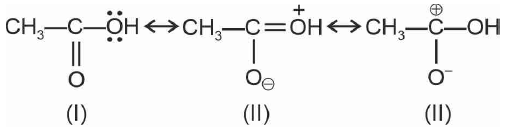
Compare the stability of resonating structures :
Correct Answer :
Solution :
The correct option is I > II > III.
To determine the relative stability of the resonating structures shown in the image, we apply the following rules of resonance in order of priority:
1. Neutral vs. Charged Structures:
Resonance structures that are neutral (without any charge separation) are more stable than those containing formal positive and negative charges because separating charges requires energy.
In the provided image, Structure (I) () is completely neutral with no formal charges. Therefore, Structure (I) is the most stable structure.
2. Completeness of Octets:
Resonance structures where all atoms have complete valence shell octets are significantly more stable than those with incomplete octets.
Let us evaluate the octets for the charged structures (II) and (III) (labeled as the middle and rightmost structures in the image, respectively):
Combining these points, the overall stability order is:
Access expert-curated educational resources and study materials—completely free.
Create, conduct, and manage professional online assessments with Crey. Perfect for teachers and institutes.
Copyright © 2026 Crey. All Rights Reserved.