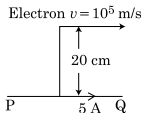
An infinitely long straight conductor carries a current of 5 A as shown. An electron is moving with a speed of 10⁵m/s parallel to the conductor. The perpendicular distance between the electron and the conductor is 20 cm at an instant. Calculate the magnitude of the force experienced by the electron at that instant.
Correct Answer :
Solution :
Correct Answer: 8 x 10-20 N
Detailed Explanation:
To find the magnitude of the force experienced by the electron, we first need to determine the magnetic field produced by the infinitely long straight conductor at the position of the electron, and then apply the magnetic force formula for a moving charge.
Step 1: Extract the given information from the question and the diagram
Based on the provided illustration, we can identify the following parameters:
- The straight conductor is labeled as and carries a current, , flowing from to .
- The electron is moving parallel to the wire (to the right) with a speed, .
- The perpendicular distance between the electron and the conductor is, .
- The magnitude of the charge of an electron is, .
- The permeability of free space is, .
Step 2: Calculate the magnetic field (B) produced by the conductor
The magnitude of the magnetic field at a perpendicular distance from an infinitely long straight current-carrying wire is given by Ampere's Law:
Substituting the given values into the formula:
Simplifying the expression:
According to the Right-Hand Grip Rule, since the current flows from left to right, the magnetic field lines form concentric circles around the wire. At the position of the electron (above the wire), the direction of the magnetic field is perpendicular to the plane of the paper, pointing outward.
Step 3: Calculate the magnetic force (F) on the electron
The magnetic force acting on a charge moving with velocity in a magnetic field is given by:
Here, is the angle between the velocity vector and the magnetic field vector . Since the electron moves parallel to the conductor (in the plane of the paper) and the magnetic field is perpendicular to the plane of the paper, the angle , and .
Substituting the values of , , and :
Thus, the magnitude of the force experienced by the electron is .
Access expert-curated educational resources and study materials—completely free.
Create, conduct, and manage professional online assessments with Crey. Perfect for teachers and institutes.
Copyright © 2026 Crey. All Rights Reserved.