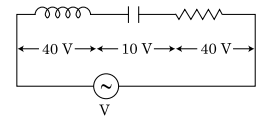
An inductor of inductance L, a capacitor of capacitance C and a resistor of resistance ‘R’ are connected in series to an ac source of potential difference ‘V’ volts as shown in figure.Potential difference across L, C and R is 40 V, 10 V and 40 V, respectively. The amplitude of current flowing through LCR series circuit is 10 2 A. The impedance of the circuit is :
Correct Answer :
Solution :
The correct answer is 5 Ω.
Step-by-step Explanation:
From the provided circuit diagram, we can observe an LCR series circuit connected to an AC source of potential difference V. The potential differences across each component are labeled as:
- Potential difference across the inductor,
- Potential difference across the capacitor,
- Potential difference across the resistor,
1. Find the RMS potential difference of the AC source:
In a series LCR circuit, the net RMS voltage is given by the formula:
Substituting the given values into the formula:
2. Find the RMS current flowing through the circuit:
We are given the peak current (amplitude of current) flowing through the circuit as .
The relation between RMS current and peak current is:
Substituting the value of :
3. Calculate the impedance of the circuit:
The impedance of the series LCR circuit is defined as the ratio of the RMS voltage to the RMS current:
Substituting the values of and :
Access expert-curated educational resources and study materials—completely free.
Create, conduct, and manage professional online assessments with Crey. Perfect for teachers and institutes.
Copyright © 2026 Crey. All Rights Reserved.