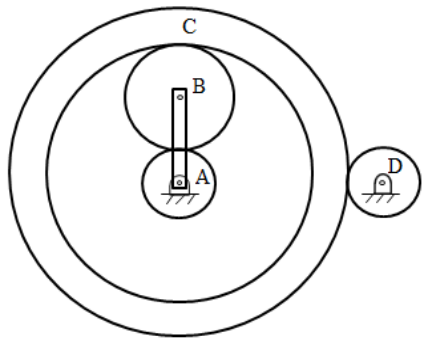
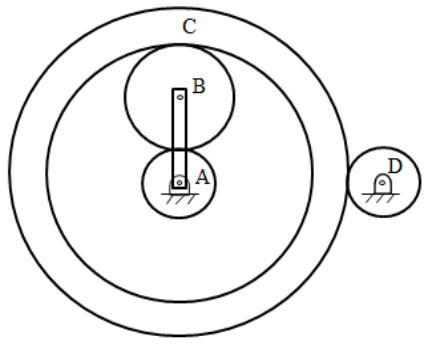
An epicyclic gear train is shown in the figure below. The number of teeth on the gears A, B and D are 20, 30 and 20, respectively. Gear C has 80 teeth on the inner surface and 100 teeth on the outer surface. If the carrier arm AB is fixed and the sun gear A rotates at 300 rpm in the clockwise direction, then the rpm of D in the clockwise direction is
Correct Answer :
375
Solution :
The correct option is 375.
1. Understanding the Gear Train Configuration from the Image:
Based on the provided diagram, the system consists of the following components:
• A sun gear A at the center, rotatable about a fixed axis.
• A planet gear B which meshes externally with sun gear A.
• A carrier arm AB that connects the centers of gears A and B.
• A ring gear C, which is a compound gear with internal teeth (meshing with B) and external teeth (meshing with D).
• An external gear D, which meshes externally with the outer surface of ring gear C and rotates about a fixed axis.
The number of teeth on each gear is given as:
• Teeth on gear A:
• Teeth on gear B:
• Inner teeth on gear C:
• Outer teeth on gear C:
• Teeth on gear D:
2. Analyzing the Motion with a Fixed Arm:
Since the carrier arm AB is fixed, the system behaves as a simple and compound gear train rather than a planetary system. We can analyze the rotation directions and speed ratios step-by-step.
Direction of Rotation:
• Let us assume the clockwise (CW) direction is positive (+), and the counter-clockwise (CCW) direction is negative (-).
• Gear A rotates in the clockwise direction:
• Since gear A and gear B mesh externally, they rotate in opposite directions. Therefore, gear B rotates counter-clockwise (CCW).
• Gear B meshes internally with the inner surface of ring gear C. In an internal mesh, the meshing gears rotate in the same direction. Thus, ring gear C also rotates counter-clockwise (CCW).
• The outer surface of ring gear C meshes externally with gear D. Since they mesh externally, they rotate in opposite directions. Because ring gear C rotates counter-clockwise (CCW), gear D must rotate clockwise (CW).
3. Calculating the Speed Ratio Step-by-Step:
First, let's find the speed relationship between gear A and the inner surface of gear C:
Multiplying these two ratios gives the speed of gear C relative to gear A:
Next, we relate the speed of gear D to the outer surface of gear C:
Now, combining the equations to express the speed of gear D directly in terms of the speed of gear A:
4. Final Calculation:
Substituting the given teeth counts and the input speed of gear A into the combined equation:
Simplifying the fractions:
Thus, the speed of gear D is 375 rpm in the clockwise direction.
Access expert-curated educational resources and study materials—completely free.
Create, conduct, and manage professional online assessments with Crey. Perfect for teachers and institutes.
Copyright © 2026 Crey. All Rights Reserved.