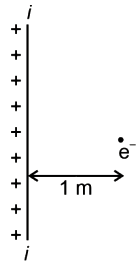
An electron is moving with speed of 1 m/s at distance of 1 m from a large sheet of charge with density σ C/m2 . Find maximum value of σ such that electron hit the sheet after 1 sec. (mass of electron 9 × 10–31 kg, permittivity of free space ε0 = 9 × 10–12 C2 /Nm2)
Correct Answer :
4.05 × 10⁻²² C/m2
Solution :
The correct answer is 4.05 × 10⁻²² C/m2.
Step-by-Step Derivation:
1. Electric Field due to an Infinite Sheet of Charge:
The electric field at a distance from a large charged sheet with surface charge density is uniform and is given by:
2. Electrostatic Force and Acceleration of the Electron:
An electron has a negative charge of magnitude . Since the sheet is positively charged, the electrostatic force pulls the electron towards the sheet:
Using Newton's second law, the magnitude of the acceleration of the electron (directed towards the sheet) is:
3. Kinematics of the Electron's Motion:
As shown in the diagram, the electron is initially at a distance from the sheet. Assuming the electron is moving away from the sheet with an initial speed , the acceleration acts as a deceleration, turning it around and bringing it back to the sheet.
Let the position represent the distance of the electron from the sheet at time :
4. Condition to Hit the Sheet after 1 second:
For the electron to hit the sheet at , we set :
This gives:
For the time of collision to be at least (i.e., hitting after ), the acceleration must satisfy , which corresponds to a maximum value of the surface charge density .
5. Calculating the Maximum Charge Density:
Using the maximum acceleration , we can solve for :
Simplifying the terms:
Access expert-curated educational resources and study materials—completely free.
Create, conduct, and manage professional online assessments with Crey. Perfect for teachers and institutes.
Copyright © 2026 Crey. All Rights Reserved.