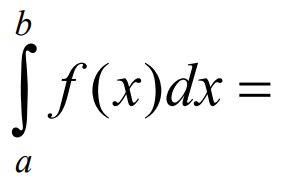
According to the Mean Value Theorem, for a continuous function
f (x) in the interval
[a,b], there exists a value
, ξ
in this interval such that 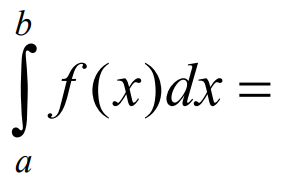
Correct Answer :
f(ξ)(b-a)
Solution :
The correct option is f(ξ)(b-a).
Image Analysis:
The provided image displays the mathematical expression for a definite integral:
where a is the lower limit of integration, b is the upper limit of integration, and f(x) is the integrand function.
Step-by-Step Explanation:
The Mean Value Theorem for Integrals (often called the First Mean Value Theorem for Integrals) states that if a function f(x) is continuous on a closed interval [a, b], there exists at least one value ξ in the interval [a, b] such that the definite integral of the function over the interval is equal to the value of the function at ξ multiplied by the length of the interval.
Mathematically, this is expressed as:
Derivation and Logic:
1. Since f(x) is continuous on the closed and bounded interval [a, b], by the Extreme Value Theorem, f(x) must attain its absolute minimum value m and absolute maximum value M on this interval:
for all x in [a, b].
2. Integrating this inequality from a to b gives:
3. Evaluating the outer integrals:
4. Dividing the entire inequality by the length of the interval (assuming b > a):
5. By the Intermediate Value Theorem, since f(x) is continuous, it must take on every value between its minimum m and maximum M. Therefore, there must exist some value ξ in the interval [a, b] such that:
6. Multiplying by yields the final relationship:
Access expert-curated educational resources and study materials—completely free.
Create, conduct, and manage professional online assessments with Crey. Perfect for teachers and institutes.
Copyright © 2026 Crey. All Rights Reserved.