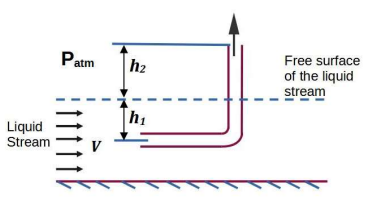
A tube of uniform diameter D is immersed in a steady flowing inviscid liquid stream of velocity V, as shown in the figure. Gravitational acceleration is represented by 𝑔. The volume flow rate through the tube is ______.
Correct Answer :
Solution :
Correct Answer:
Step-by-Step Explanation:
1. Analysis of the Physical System from the Diagram:
Based on the provided illustration, we have a horizontal liquid stream flowing at a constant velocity . The liquid is assumed to be inviscid (ideal fluid with zero viscosity) and the flow is steady.
A tube of uniform diameter is immersed in the stream:
• The horizontal inlet of the tube (let's call this Point 1) is located at a depth below the "Free surface of the liquid stream".
• The tube bends upwards and extends above the free surface to a height , where the fluid exits into the atmosphere (labeled Point 2 at pressure ).
2. Determining Pressure at the Inlet and Exit:
Let us consider a point in the undisturbed upstream fluid at the same elevation as the tube inlet (let's call it Point 0):
Since this point is at a depth of below the free surface (which is exposed to the atmosphere at pressure ), the static pressure at this location is:
where is the density of the liquid, and is the acceleration due to gravity.
At the tube's exit (Point 2), the liquid is discharged directly to the atmosphere, meaning the pressure at the exit is atmospheric:
3. Applying Continuity inside the Tube:
Since the tube has a uniform diameter , its cross-sectional area is constant throughout. By the conservation of mass (continuity equation for an incompressible fluid), the velocity of the liquid flow inside the tube must be constant from the inlet (Point 1) to the exit (Point 2):
4. Applying Bernoulli's Equation between Point 1 (Inlet) and Point 2 (Exit):
Applying Bernoulli's equation along the streamline inside the tube:
Since and , the kinetic energy terms cancel out:
Rearranging the terms:
Looking at the dimensions in the diagram, the vertical distance between the inlet and the outlet is:
Thus, the pressure at the inlet of the tube is:
5. Applying Bernoulli's Equation between Point 0 (Undisturbed Stream) and Point 1 (Tube Inlet):
We apply Bernoulli's equation along a streamline from the far upstream free-flowing liquid stream (where velocity is and pressure is ) to just inside the entrance of the tube (where velocity is and pressure is ):
Substitute the values of and into the equation:
Subtract from both sides:
Divide the entire equation by :
Solving for the flow velocity in the tube :
6. Calculating Volume Flow Rate:
The volume flow rate through a tube of uniform cross-sectional area is given by:
For a tube with circular cross-section and diameter , the cross-sectional area is:
Substituting and into the flow rate equation:
Access expert-curated educational resources and study materials—completely free.
Create, conduct, and manage professional online assessments with Crey. Perfect for teachers and institutes.
Copyright © 2026 Crey. All Rights Reserved.