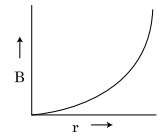
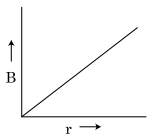
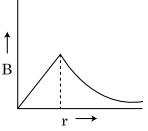
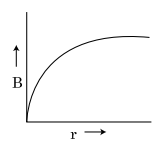
A thick current carrying cable of radius ‘R’ carries current ‘I’ uniformly distributed across its cross-section. The variation of magnetic field B(r) due to the cable with the distance ‘r’ from the axis of the cable is represented by :
Correct Answer :
Solution :
To find the variation of the magnetic field due to a thick current-carrying cable of radius carrying a uniformly distributed current at a distance from the axis, we can apply Ampere's Circuital Law.
Ampere's Circuital Law states that the line integral of the magnetic field around a closed loop is equal to times the total current enclosed by the loop:
We consider two cases based on the distance from the axis of the cable:
Case 1: Inside the cable ()
Since the current is uniformly distributed across the cross-sectional area , the current density is:
The current enclosed within an Amperean loop of radius is:
Applying Ampere's Law for the circular loop of radius :
Solving for gives:
Therefore, inside the cable, the magnetic field is directly proportional to :
(which represents a straight line starting from the origin).
At the surface of the cable where , the magnetic field reaches its maximum value:
Case 2: Outside the cable ()
For an Amperean loop of radius outside the cable, the total enclosed current is the entire current flowing through the cable:
Applying Ampere's Law:
Solving for gives:
Therefore, outside the cable, the magnetic field is inversely proportional to :
(which represents a rectangular hyperbola).
Conclusion:
The variation is represented by a linear increase from to , followed by a hyperbolic decrease for . Looking at the provided options, Option 3 (shown in the third image) correctly depicts this variation with a dashed vertical line marking the boundary at .
Access expert-curated educational resources and study materials—completely free.
Create, conduct, and manage professional online assessments with Crey. Perfect for teachers and institutes.
Copyright © 2026 Crey. All Rights Reserved.