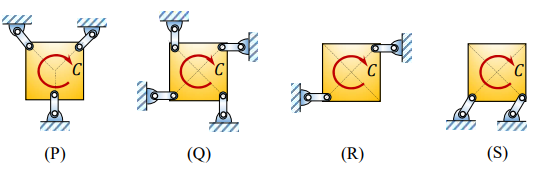
A square plate is supported in four different ways (configurations (P) to (S) as shown in the figure). A couple moment 𝐶 is applied on the plate. Assume all the members to be rigid and mass-less, and all joints to be frictionless. All support links of the plate are identical. The square plate can remain in equilibrium in its initial state for which one or more of the following support configurations?
Correct Answer :
Solution :
The correct support configurations that allow the square plate to remain in equilibrium are Configuration (Q), Configuration (R), and Configuration (S).
For any two-dimensional rigid body (like the square plate in the figure) to remain in static equilibrium, it must satisfy three conditions:
• Force equilibrium along the horizontal direction:
• Force equilibrium along the vertical direction:
• Moment equilibrium about any arbitrary point:
Since the support links are rigid, two-force members with frictionless pins at both ends, the reaction force exerted by each link acts strictly along its longitudinal axis (its line of action).
In Configuration (P), the plate is supported by three links. Looking closely at the image, the dashed lines indicate that the lines of action of all three support links intersect exactly at a single point (the center of the plate).
Because all of the support forces pass directly through the center of the plate, the perpendicular distance (lever arm) from the center to any of these reaction forces is zero. Therefore, these support reaction forces cannot generate any moment about the center of the plate.
When the external couple moment
is applied, the net moment about the center of the plate is:
Since the moment cannot be balanced, Configuration (P) cannot remain in equilibrium.
In Configuration (Q), the plate is supported by four links: two vertical links (at the top-left and bottom-right) and two horizontal links (at the bottom-left and top-right).
The lines of action of these support links do not intersect at a single point. As a result, the horizontal and vertical reaction forces can easily develop to counteract the applied couple moment
while maintaining both horizontal and vertical force equilibrium. Therefore, Configuration (Q) can remain in equilibrium.
In Configuration (R), the plate is supported by two horizontal links connected to the bottom-left and top-right corners.
The forces in these two links act along parallel, non-collinear horizontal lines. For horizontal force equilibrium:
These two equal and opposite forces separated by a vertical distance
form a couple of magnitude
which can directly balance the applied couple moment
. Since there are no vertical forces, all equilibrium equations are satisfied. Therefore, Configuration (R) can remain in equilibrium.
In Configuration (S), the plate is supported by two parallel inclined links at the bottom.
Similar to Configuration (R), because the links are parallel but not collinear, they can carry equal and opposite forces along their parallel axes. These equal and opposite forces form a couple that counteracts the applied couple moment
while maintaining complete force equilibrium. Therefore, Configuration (S) can remain in equilibrium.
Access expert-curated educational resources and study materials—completely free.
Create, conduct, and manage professional online assessments with Crey. Perfect for teachers and institutes.
Copyright © 2026 Crey. All Rights Reserved.