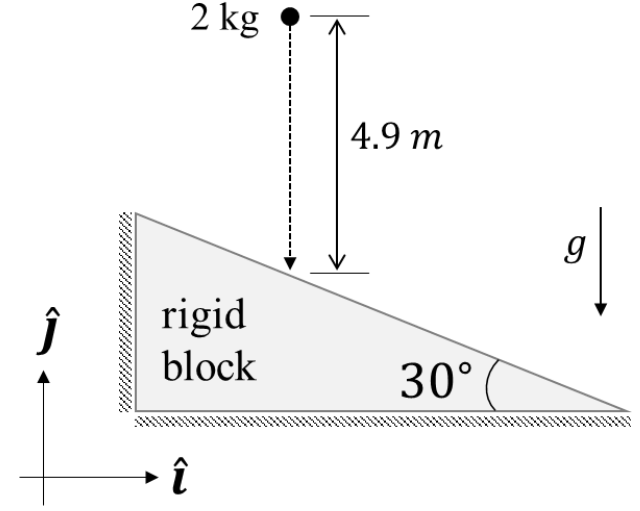
A spherical ball weighing 2 kg is dropped from a height of 4.9 m onto an immovable rigid block as shown in the figure. If the collision is perfectly elastic, what is the momentum vector of the ball (in kg m/s) just after impact?
Take the acceleration due to gravity to be 𝑔 = 9.8 m/s² . Options have been rounded off to one decimal place.
Correct Answer :
17.0 𝒊̂+ 9.8 𝒋̂
Solution :
The correct option is: 17.0 + 9.8
Step 1: Analyzing the given information from the question and the diagram
Based on the provided illustration, we can observe the following details:
• Mass of the spherical ball,
• Height from which the ball is dropped,
• The acceleration due to gravity, , directed vertically downwards.
• The immovable rigid block has an inclined face that makes an angle of with the horizontal ground.
• The coordinate system is oriented such that points horizontally to the right, and points vertically upwards.
Step 2: Velocity of the ball just before collision
The ball is dropped from rest under the influence of gravity. Using the equation of motion for a freely falling body, the speed just before it hits the inclined surface is:
Substituting the given values:
Since the ball falls vertically downwards in the negative direction, the velocity vector just before collision is:
Step 3: Geometry of the inclined surface
Let us define the unit tangent vector along the inclined plane (directed downwards and to the right) and the unit normal vector pointing outwards (upwards and to the right):
Step 4: Finding the velocity components just before impact
We resolve the pre-impact velocity into its components along the normal () and tangential () directions:
Step 5: Applying the conditions of a perfectly elastic collision
Since the collision is perfectly elastic and the rigid block is immovable:
1. The component of velocity parallel (tangential) to the slope remains unchanged:
2. The component of velocity perpendicular (normal) to the slope is reversed:
Step 6: Velocity vector just after impact
Combining the components back into a single vector :
Substituting the expressions for and :
Simplifying by factoring out 9.8:
Using trigonometric identities:
•
•
Substituting these identities:
Since and :
Step 7: Momentum vector just after impact
The momentum vector just after collision is given by:
Substituting :
Rounding off to one decimal place, we obtain:
Access expert-curated educational resources and study materials—completely free.
Create, conduct, and manage professional online assessments with Crey. Perfect for teachers and institutes.
Copyright © 2026 Crey. All Rights Reserved.